

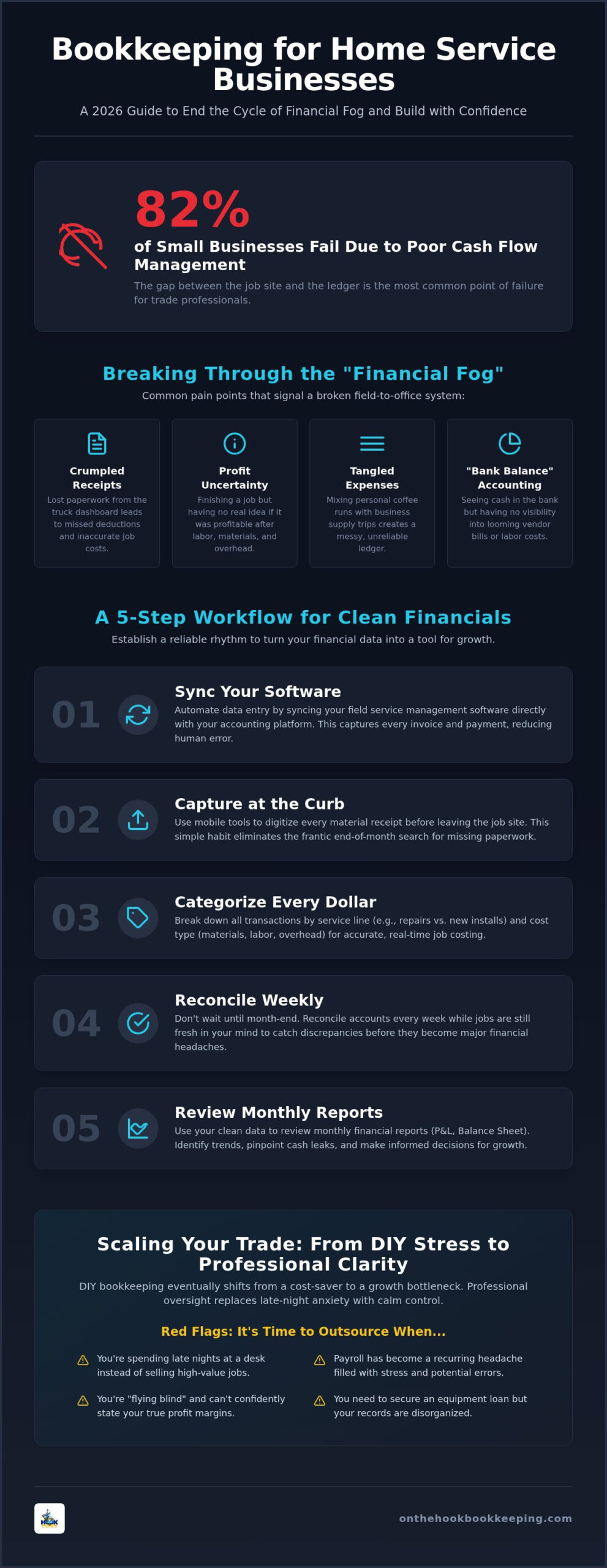
Did you know that 82% of small businesses fail simply because of poor cash flow management? For a trade professional, the office is usually a truck dashboard rather than a quiet desk. You know the frustration of finding a crumpled receipt for a major part at the bottom of a tool bag weeks too late. It’s exhausting to finish a long day only to wonder if that last install actually made a profit or just covered your crew’s overtime. This 2026 guide to bookkeeping for home service businesses is designed to end that cycle of financial fog.
Learn how to bridge the gap between the job site and your ledger with a clean, scalable system built for the trades. We’ll walk through organizing your transactions, mastering the mid-year 2026 mileage rate shifts, and building the visibility you need to grow with confidence.
Key Takeaways
- Stop the “field-to-office” friction by establishing a direct, digital link between your job site receipts and your financial ledger.
- Implement a structured system of bookkeeping for home service businesses that reconciles accounts weekly to ensure your data stays as fresh as your latest project.
- Move beyond “bank-balance accounting” by using monthly financial reports to gain clear visibility into your true job margins and crew profitability.
- Identify the strategic moment to transition from DIY stress to professional oversight, replacing financial anxiety with a sense of calm, grounded control.
Bridging the Gap: Why Home Service Bookkeeping Often Fails
Effective bookkeeping for home service businesses acts as the mechanical link between the dust of the job site and the stability of your bank account. While standard methods of bookkeeping focus on the basic recording of transactions, the trades require a more specialized approach. Friction usually starts in the field. When receipts disappear under truck seats and invoices sit in a “to-do” pile, you’re left with a false bank balance. You see cash in the account, but you don’t see the looming vendor bills or the true cost of labor. Generic banking apps often fail growing companies because they lack the depth needed for detailed job costing and crew management. Building a system for professional bookkeeping for trades is the only way to replace that “gut-feeling” management with hard data. Establishing a reliable system for bookkeeping for home service businesses turns your financial data into a tool for growth rather than a source of stress.
Managing Receipts and Expenses from the Service Truck
Stop the paper trail before it gets cold. We recommend a “capture at the curb” policy: use mobile tools to digitize every material receipt before you even leave the job site. This simple habit eliminates the frantic search for missing paperwork at the end of the month. It also helps you avoid the “messy QuickBooks” trap where personal coffee runs and business supply trips get tangled together. Keeping your business and personal spending strictly separate is a non-negotiable step for long-term sanity. Transaction categorization is the key to seeing real-time job margins so you know exactly how much you’re making on every call.
A 5-Step Workflow for Clean Home Service Financials
Clean books don’t happen by accident. They require a rhythm. To effectively manage your finances, you need a workflow that moves as fast as your crews. Start by syncing your field service management software directly with your accounting platform. This automation captures every invoice and payment without manual data entry, reducing the risk of human error. Next, reconcile your accounts weekly. Doing this while jobs are still fresh in your mind allows you to catch discrepancies before they snowball into larger financial headaches. Categorizing every dollar to specific service lines, such as repairs versus new installations, gives you the power to see which parts of your business are actually profitable. Finally, review your monthly financial reports to identify exactly where cash might be leaking from your operations. If your current books feel like a tangled mess, our cleanup and catch-up support can restore order.
Categorizing Transactions for Accurate Job Costing
Success in bookkeeping for home service businesses depends on the details. Break down expenses into materials, labor, and overhead to understand your true cost per lead. Consistent naming conventions in QuickBooks ensure your small business bookkeeping services provide clear, actionable data for scaling. This level of organization prepares your records for a seamless tax-time handoff, removing the end-of-year scramble for missing documentation. When your ledger is organized by job type, you stop guessing and start knowing your real-time margins. This visibility is the foundation of confident decision-making.
Scaling Your Trade: Moving from DIY Stress to Professional Clarity
Building a home service business from the ground up requires immense grit. You’ve likely spent years mastering your trade while simultaneously trying to manage the back office. Eventually, DIY bookkeeping for home service businesses shifts from a cost-saving measure to a growth bottleneck. When you’re stuck at a desk until midnight, you aren’t out selling high-value jobs or optimizing your crew’s schedule. Professional oversight replaces this late-night anxiety with a sense of calm control and empowered decision-making. By stopping doing your own bookkeeping, you reclaim the time needed to focus on high-level operations. A steady financial partner acts as your advocate, handling the heavy lifting of administration so you can return to your primary passion. This partnership fine-tunes your company’s inner workings for better performance.
When to Outsource Your Bookkeeping and Payroll
How do you know when you’ve reached the tipping point? Several signs are unmistakable. You might be missing tax deadlines, finding that payroll is a recurring headache, or feeling like you’re “flying blind” regarding actual profit margins. Clean historical records are essential if you plan on securing equipment loans or expanding your fleet. Lenders need to see stability and mechanical efficiency in your records, not a disorganized ledger. Regular monthly financial reporting provides the visibility required to scale your crew and service area with confidence. Transitioning to professional support ensures your foundation is strong enough to support the weight of your growing ambitions. It moves you from a state of uncertainty toward a definitive and simple path for expansion.
Build Your Business on a Foundation of Financial Clarity
Transitioning from the chaos of crumpled receipts to a structured ledger is the most significant upgrade you can give your trade. By establishing a reliable system for bookkeeping for home service businesses, you replace the anxiety of “flying blind” with the confidence of clear data. You’ve learned how to capture expenses at the curb and why weekly reconciliation keeps your margins visible. Now, it’s time to reclaim your evenings and focus on the high-value jobs that drive your growth.
Whether you need specialized cleanup for messy historical records or reliable payroll solutions for your growing crew, we handle the heavy lifting of administration. Our monthly financial reports provide the visibility you need to scale with certainty. Get your time back with professional bookkeeping for your home service business. You’ve put in the grit to build this company; let us provide the steady hand that helps it thrive.
Frequently Asked Questions
How do I fix messy QuickBooks records if I am months behind?
The most effective path is utilizing project-based cleanup and catch-up services to untangle historical records. You start by reconciling bank statements against digital receipts to ensure every transaction is accounted for. This process removes the administrative burden from your shoulders and prepares your books for loan applications or a clean year-end handoff. It’s about restoring order to a chaotic financial environment.
What is the best way to track crew payroll for home service businesses?
Integrating your field management software with a dedicated payroll system is the gold standard for accuracy. This digital link ensures hours recorded on the job site translate directly into paychecks without manual data entry. Reliable payroll solutions handle the recurring heavy lifting of administration, which keeps your team happy and your business compliant with standard reporting requirements.
Should I use a professional bookkeeper or just stick with QuickBooks?
Software is simply a tool; professional bookkeeping for home service businesses provides the steady hand that interprets the data. While QuickBooks records transactions, a bookkeeper ensures your accounts are reconciled weekly and categorized correctly. This oversight replaces financial anxiety with calm control, giving you the visibility needed to make empowered growth decisions rather than guessing based on a bank balance.
How can bookkeeping help me improve my profit margins on service calls?
Detailed transaction categorization reveals the true cost of materials, labor, and overhead for every project. When you review monthly financial reports, you gain visibility into exactly where cash might be leaking from your operations. This data allows you to identify your most profitable service lines and adjust your pricing or processes to fine-tune your company’s overall performance.