

DIY bookkeeping isn’t just a time-sink; it’s a structural ceiling that prevents your business from scaling beyond your personal capacity. You likely started this venture to build something meaningful, not to lose your Sunday afternoons to a maze of transaction categorizations. It’s exhausting to work sixty hours a week and still feel a nagging anxiety that an incorrect filing or navigating complex tax requirements, such as accurate 1099-NEC filings, could derail your progress. When you decide to stop doing your own bookkeeping, you trade that constant worry for the clarity of professional records. You deserve to know exactly where your money goes without the headache of manual data entry.
This guide will show you why 2026 is the pivotal year to outsource your financial management so you can reclaim your time and unlock real growth. We will examine the hidden costs of the DIY approach, the impact of evolving tax laws and new compliance demands, and how professional support from experts like On the Hook Bookkeeping provides the data you need for confident decision-making. By moving from a state of financial confusion to one of empowered control, you can finally focus on the primary passion that drove you to start your business in the first place.
Key Takeaways
- Recognize how diverting your high-value energy toward administrative tasks creates a structural ceiling that prevents your business from scaling.
- Identify the specific operational red flags, such as sixty-day delays in transaction categorization, that indicate it is time to stop doing your own bookkeeping.
- Understand why accounting software is a tool rather than a strategy and why human oversight is still essential for accurate financial visibility.
- Learn how a professional cleanup and catch-up phase can transform messy records into a reliable foundation for monthly growth decisions.
- Discover how offloading payroll and transaction management restores your focus and replaces financial anxiety with a sense of calm control.
The Hidden Cost of DIY: Why Your Time is Your Most Expensive Asset
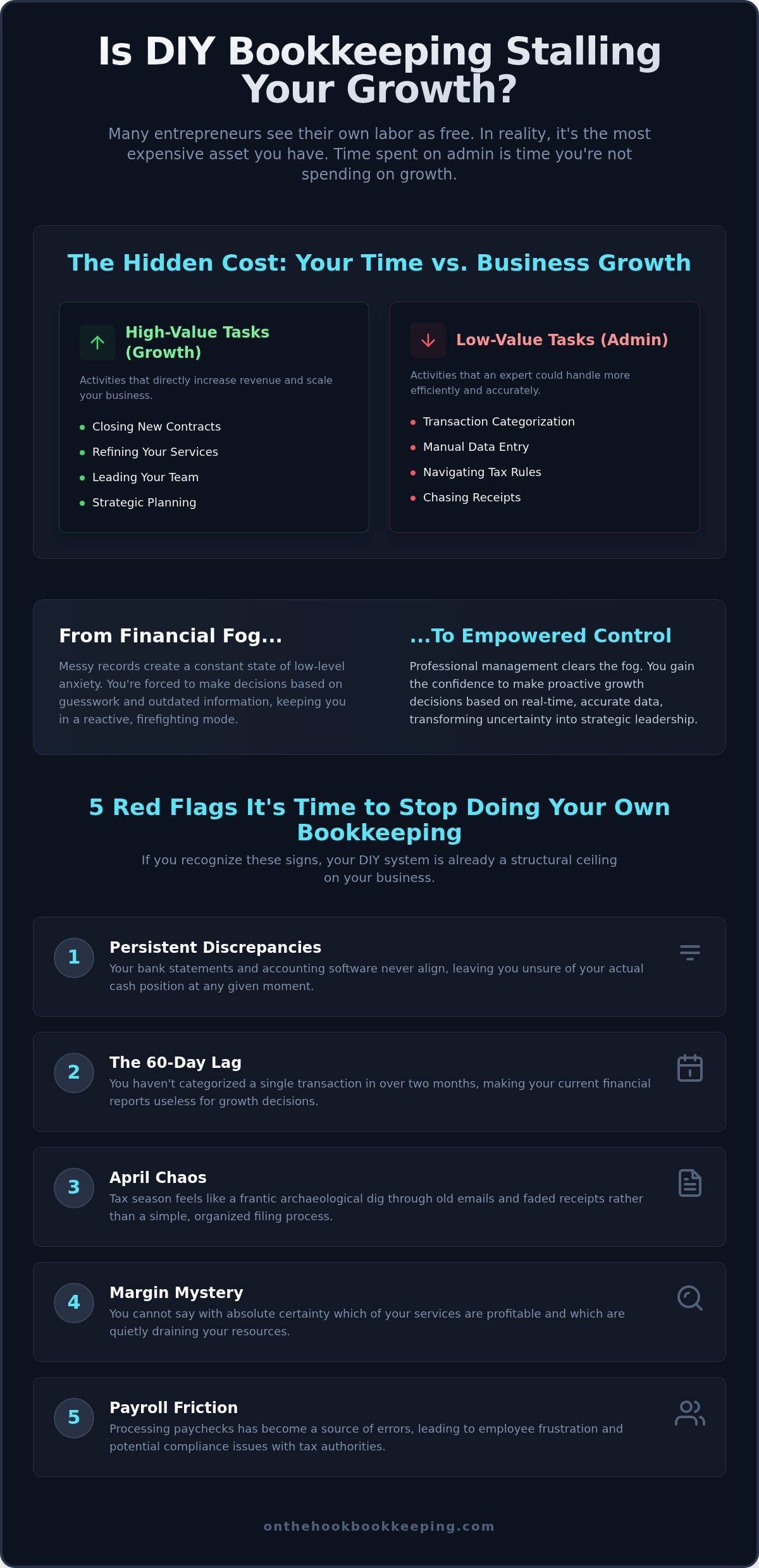
Many entrepreneurs view their own labor as an infinite, free resource. It’s a common trap born from the grit required to start a business. You assume that handling every transaction yourself is the most fiscally responsible path. However, when you refuse to stop doing your own bookkeeping, you aren’t actually saving money. You’re incurring a heavy, invisible debt that slows your momentum and drains your energy.
For a small business owner, opportunity cost is the measurable loss of potential revenue or strategic growth that occurs when you choose to perform administrative tasks instead of high-value, revenue-generating activities.
Think about your most productive hour. Perhaps you’re closing a new contract, refining a service, or leading your team toward a major milestone. That hour might be worth hundreds of dollars to your company’s bottom line. When you spend that same hour struggling with standard methods of bookkeeping, you are effectively paying yourself a premium rate to do a job that an expert could handle more accurately. This isn’t just inefficient; it’s a structural ceiling on your growth. This burden rarely stays at the office, either. It often manifests as “Sunday Night Stress,” where your personal time is sacrificed to catch up on entries you were too busy to handle during the week.
Calculating Your Real Hourly Rate
To find your true value, look at your business’s growth potential rather than just your current take-home pay. If delegating administrative work allows you to focus on sales or operational efficiency, the return on that time is your real hourly rate. The math of delegation is simple: you spend money to buy back high-value hours. Choosing to stop doing your own bookkeeping is an investment in your capacity to lead. “Free” DIY is the most expensive option you have because it consumes the only non-renewable resource available to you: your time.
The Mental Burden of Financial Fog
Beyond the clock, there is a psychological weight to messy records. Not knowing your exact numbers creates a constant state of low-level anxiety. You might second-guess every purchase or feel a spike of dread when checking your bank balance because the data is sixty days behind. This “financial fog” keeps you in a reactive, firefighting mode. When you move toward professional management, you clear that fog. You transition from a state of uncertainty to a position of proactive leadership, making growth decisions based on real data rather than gut feelings and guesswork.
5 Signs You Should Stop Doing Your Own Bookkeeping Immediately
Identifying the exact moment your DIY system breaks is critical for your business’s survival. Most owners don’t realize they’ve crossed the line until they’re facing a genuine crisis or a looming deadline. If you see these five red flags, it’s time to stop doing your own bookkeeping before the operational damage becomes permanent. Holding on too long doesn’t show grit; it shows a lack of strategic focus that will eventually stall your progress.
- Persistent Discrepancies: Your bank statement and software never quite align, leaving you unsure of your actual cash position at any given moment.
- The 60-Day Lag: You haven’t categorized a single transaction in over two months, making your current financial reports useless for making growth decisions.
- April Chaos: Tax season feels like a frantic archaeological dig through old emails and faded receipts rather than a simple, organized filing process.
- Margin Mystery: You cannot say with absolute certainty which of your services are profitable and which are quietly draining your resources.
- Payroll Friction: Processing paychecks has become a source of errors, leading to employee frustration and potential compliance issues with tax authorities.
The Red Flag of Messy QuickBooks Records
An “uncategorized” transaction folder is a ticking time bomb for your CPA. When you co-mingle personal and business expenses, you blur the lines of your business entity and significantly increase your audit risk. Organizing your historical records is about more than just neatness; it’s about legal and financial protection. To effectively manage your finances and prepare for future lending, your records must be clean and current. With the 2026 reporting threshold for Forms 1099-MISC and 1099-NEC increased to $2,000, missing a single vendor categorization can lead to significant compliance gaps. If your books are currently a maze of errors, a professional cleanup and catch-up partner can untangle the past so you can move forward with a clean slate.
When Growth Outpaces Your Admin Capacity
There is a specific tipping point where more customers actually lead to more headaches instead of more profit. Your old system of spreadsheets or physical receipts won’t scale with a growing team or higher transaction volume. You eventually become the bottleneck. Your business cannot expand if you’re stuck in the weeds of manual data entry every weekend. Recognizing this ceiling is the first step toward building a scalable foundation. Moving from reactive firefighting to proactive leadership requires a system that functions without your constant, direct intervention. It’s about building a machine that supports your vision rather than one that demands all your remaining energy. Investing in small business bookkeeping services gives you that scalable system, turning your financial records from a source of dread into a reliable map for growth.
Professional Bookkeeping vs. Software: Why QuickBooks Isn’t Enough
QuickBooks is a powerful engine. It isn’t the driver. Many small business owners believe that a software subscription is a substitute for financial expertise. They assume the software will “do the work” for them. This is a dangerous misconception. While modern tools provide the infrastructure for your records, they require a steady, expert hand to remain accurate. When you stop doing your own bookkeeping, you move beyond mere data entry and into the realm of true financial intelligence.
The myth of “automated” bookkeeping is pervasive. While the AI in accounting market was valued at approximately $6.8 billion in 2025 and is projected to grow by about 26% annually through the early 2030s, technology still lacks human judgment. An algorithm can categorize a transaction based on past patterns, but it doesn’t understand the strategic “why” behind your spending. It won’t know if a specific purchase was a one-time capital investment or a recurring operational cost. Relying solely on automation often leads to a “garbage in, garbage out” scenario where your reports look clean but represent a distorted reality. If you’re still weighing the QuickBooks vs professional bookkeeper decision for your small business, understanding where software ends and human expertise begins is the critical first step.
The Human Element: Catching What the App Misses
Software is blind to context. It cannot spot a duplicated invoice from a vendor who accidentally billed you twice. It doesn’t notice when a bank feed silently drops for forty-eight hours, leaving a hole in your records. Professional reconciliation is the essential “sanity check” that verifies every penny matches the real-world movement of cash. A human partner looks at your spending with a protective eye, identifying anomalies that an app would simply ignore. This level of oversight ensures your data integrity remains unshakeable.
Visibility into Your Margins
There is a vast difference between having data and having insights. Your bank balance tells you if you can pay the bills today, but it doesn’t tell you if you’re actually profitable. Strategic financial recordkeeping involves breaking down your costs to see where capital is being wasted and where it’s being optimized. When you stop doing your own bookkeeping, you receive monthly financial reports that translate rows of numbers into a clear narrative. You gain the visibility required to understand your true margins, allowing you to make growth decisions based on hard evidence rather than a gut feeling about your checking account balance.
Making the Switch: How to Hand Over Your Financials Safely
Handing over the keys to your business financials feels like a significant leap of faith. It’s natural to feel protective of the records you’ve built with your own grit. However, when you decide to stop doing your own bookkeeping, the transition doesn’t mean losing sight of your money. It means gaining a clearer lens through which to view it. A structured handover replaces the chaos of manual entries with a reliable system designed for stability and growth.
The Cleanup Process: Fixing the Past
Most business owners don’t start with perfect records. You likely have a backlog of uncategorized expenses or bank feeds that haven’t been reconciled in months. When a professional dives into your historical data, they perform a comprehensive “cleanup and catch-up” phase. This process untangles past errors, identifies duplicate entries, and ensures every transaction is mapped to the correct account. A clean slate is necessary for accurate future forecasting. Whether you’re applying for a business loan or preparing for a smooth tax season, having verified, historical data is your strongest asset. It provides the foundation upon which all future growth is built.
Retaining Control While Delegating
Delegation is not abdication. You remain the primary decision-maker; your bookkeeper simply provides the high-fidelity data you need to choose wisely. Professional firms use view-only access for bank accounts and credit cards, which maintains a high level of security while allowing for efficient data pulls. These professional internal controls actually increase your control over the business. You’re no longer reacting to bank balance surprises. Instead, you’re leading with facts. If you’re ready to clear the fog and secure your records, our team specializes in cleanup and catch-up support to get your business back on the right track.
Establishing a recurring payroll workflow is another critical step in the transition. By setting up a reliable, automated system for employee payments, you remove the weekly friction and anxiety of manual processing. Once the mechanical work is off your plate, your focus shifts to high-level oversight. You maintain this visibility through monthly Profit and Loss (P&L) statements and balance sheets. These reports act as your business dashboard. They show you exactly where you stand at the end of every month without requiring you to touch a single spreadsheet or spend another Sunday night staring at QuickBooks.
Partnering for Growth: The On the Hook Bookkeeping Approach
At On the Hook Bookkeeping, we understand that your business is built on grit, late nights, and a vision for the future. Our mission is to replace the constant hum of financial anxiety with a sense of grounded, quiet confidence. We don’t just process numbers. We provide the stability you need to lead effectively. When you finally decide to stop doing your own bookkeeping, you aren’t just offloading a task; you’re gaining a partner dedicated to your company’s mechanical efficiency and long term health.
Our monthly bookkeeping services are specifically designed for the unique challenges of small business owners and trades. For contractors and skilled tradespeople especially, professional bookkeeping for trades provides the financial scaffolding that turns hard work on the job site into a scalable, predictable business asset. We focus on the mechanical inner workings of your company, ensuring every transaction is categorized with precision. This methodical approach creates a clear, predictable flow of information. You gain access to accurate payroll solutions that ensure your team is paid on time, every time, removing one of the most common sources of administrative friction. By establishing these reliable systems, we help you move from a state of confusion to one of empowered decision making.
A Steady Hand for Your Business
We act as a protective advocate for your company’s financial health. Traditional accounting firms often feel detached, providing rows of data without the context you need to actually run your business. We opt for a supportive, approachable partnership instead. We act as the steady hand that provides clarity in an often chaotic environment. This collaboration ensures you have the visibility into business margins you’ve been missing. You will finally understand exactly where your capital is going and which parts of your operation are generating the most value. Clear, accessible financial reporting becomes your most powerful tool for growth, allowing you to fine tune your performance based on real data rather than guesswork.
Ready to Get Your Time Back?
The first step toward financial calm is a simple consultation to assess your current needs. Whether your QuickBooks records require a deep cleanup or you simply need a reliable monthly rhythm for your accounts payable and receivable, we handle the heavy lifting. We take over the administration so you can return to your primary passion. You didn’t start this business to be a full time administrator. You started it to build something meaningful. We provide the organized foundation that allows you to focus on that vision while we maintain the engine. If you are ready to reclaim your weekends and lead with confidence, it is time to take action. Stop doing your own bookkeeping and start growing your business with On the Hook Bookkeeping.
Building a Foundation for Your Next Level of Growth
You’ve worked hard to build your business from the ground up, but your energy is better spent on leadership than on manual data entry. Professional management turns financial chaos into a strategic roadmap. When you decide to stop doing your own bookkeeping, you gain the clarity of clean, up-to-date records that empower every growth decision. Whether you require expert cleanup for messy historical records or reliable payroll solutions for your small business team, having an advocate for your financial health changes the trajectory of your company.
Reclaiming your time is the first step toward a scalable future. It’s time to clear the fog and return to the primary passion that drove you to start this journey. Get Your Time Back – Explore Our Bookkeeping Services and discover how a grounded partnership can replace anxiety with empowered control. You have the grit to build something great; let us provide the stability to help you get there.
Frequently Asked Questions
Is it worth paying a bookkeeper for a very small business?
Investing in professional support is a strategic move for growth. When you stop doing your own bookkeeping, you reclaim high-value hours that can be spent on revenue-generating activities. Even for the smallest ventures, accurate financial records provide the visibility needed to understand your margins and make informed decisions. It replaces the anxiety of “not knowing your numbers” with a sense of calm, professional control.
What is the difference between a bookkeeper and a CPA?
Bookkeepers and CPAs perform distinct roles in your financial ecosystem. A bookkeeper focuses on the daily and monthly mechanics, such as transaction categorization, account reconciliation, and delivering financial reports. A CPA typically handles high-level tax strategy, auditing, and tax filing. By maintaining clean records throughout the year, a bookkeeper ensures your CPA has accurate data to work with, often reducing your overall tax preparation costs.
How much does it cost to hire a professional bookkeeping service?
The cost of professional bookkeeping is an investment in your business’s operational efficiency. Fees are generally based on the volume of transactions and the complexity of your financial accounts. While prices vary, the real cost to consider is your own hourly rate. Outsourcing these tasks is almost always more cost-effective than an owner spending their limited time on administrative work instead of growing the business.
Can a bookkeeper help me fix my messy QuickBooks records from last year?
Yes, we specialize in cleanup and catch-up support for businesses with disorganized QuickBooks records. If you’ve fallen behind or made errors in your historical data, we can untangle those entries to provide a clean slate. This process is essential if you’re preparing for a loan application or a tax-time handoff. We turn historical confusion into an organized foundation for your future growth.
Will I lose control of my bank accounts if I hire a bookkeeper?
You retain complete authority over your finances at all times. Professional bookkeepers typically use view-only access to your bank and credit card feeds. This allows for efficient data retrieval and reconciliation without the ability to move funds or change account settings. This setup provides the necessary visibility for accurate recordkeeping while maintaining the highest level of security and control for the business owner.
What documents do I need to provide to a monthly bookkeeping service?
To maintain accurate records, you’ll need to provide access to your bank and credit card statements, payroll reports, and records of business spending. We also require information on any new loans or major asset purchases. Our goal is to create a methodical communication rhythm that minimizes your administrative burden. Most of this data can be pulled automatically once the initial systems are established.
How does professional bookkeeping help with my business taxes?
Professional bookkeeping provides the clean, tax-ready financial records your tax preparer needs to file accurately. By ensuring every transaction is correctly categorized throughout the year, you avoid the risk of missing valuable deductions. This organization also eliminates the frantic scramble for receipts in April. We focus on providing the visibility into business margins that makes the tax filing process smooth and predictable.
Can a bookkeeper also handle my small business payroll?
We offer comprehensive payroll solutions, including setup and recurring workflows. This ensures your employees are paid accurately and on time without you having to manage the weekly administrative friction. We handle the heavy lifting of payroll record organization and reporting, integrating these figures directly into your monthly financial reports. This unified approach gives you a complete picture of your labor costs and business health.