

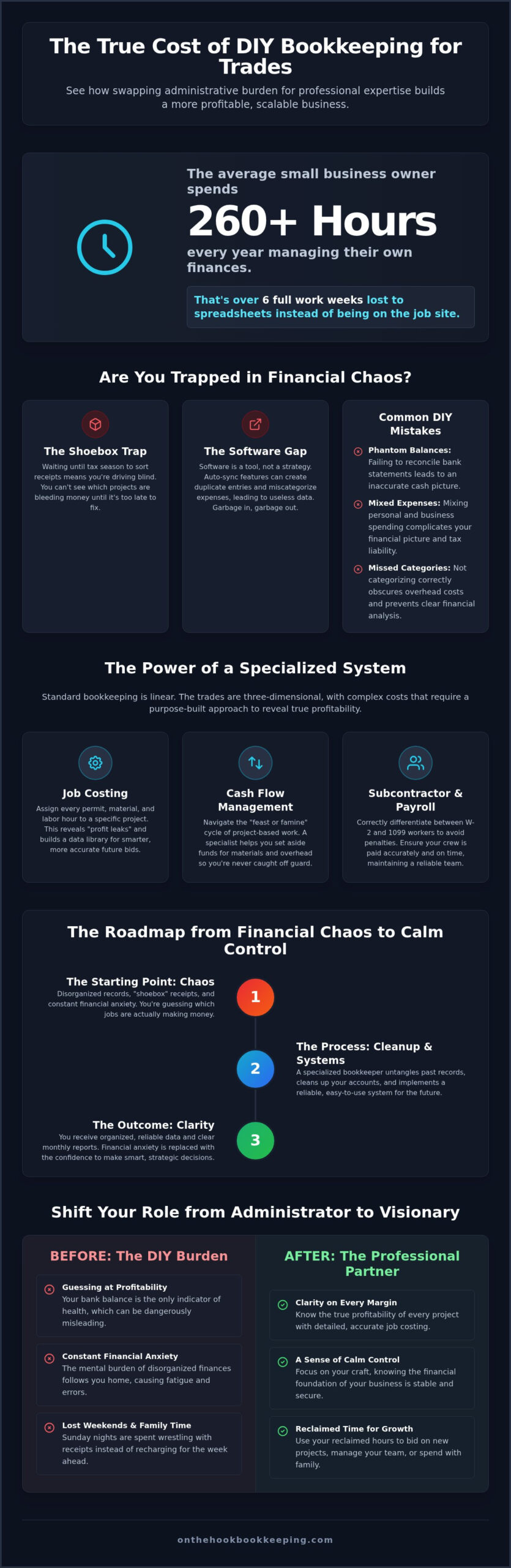
Did you know the average small business owner spends over 260 hours every year managing their own finances? That is more than six full work weeks lost to spreadsheets and software when you should be on the job site or with your family. You started your company because you are an expert at your craft, not because you wanted to spend your Sunday nights wrestling with QuickBooks and messy receipts. It is frustrating to work twelve-hour days and still feel like you are guessing which jobs are actually making money.
Professional bookkeeping for trades is the financial scaffolding that turns your hard work into a scalable, predictable asset. We understand that disorganized records create a heavy mental burden that follows you home long after the tools are put away. By implementing specialized systems, you can replace that financial anxiety with a sense of calm control. This article explores how specialized bookkeeping removes chaos and protects your margins, giving you the clarity to grow your business with confidence.
Key Takeaways
- Understand why the DIY “shoebox” approach drains your cash flow and how to calculate the true cost of losing billable hours to administrative tasks.
- Discover how professional bookkeeping for trades tracks complex job costs and material fluctuations to reveal the actual profitability of every project.
- Learn why your bank balance can be a misleading indicator of business health and how monthly reports provide the visibility you need to scale.
- Follow a clear roadmap to untangle messy records through specialized cleanup services, moving your business from financial chaos to organized, reliable data.
- Shift from being a solo administrator to having a steady partner who handles the heavy lifting of daily accounts and payroll integration.
The Hidden Cost of DIY Bookkeeping in the Trades
Many tradespeople start with a shoebox full of receipts or a chaotic folder on their dashboard. It’s a common strategy: work hard all year and sort it out when tax season arrives. But waiting until the end of the year to look at your numbers is like driving a truck with a blacked-out windshield. You can’t see the obstacles until you’ve already hit them. This “shoebox trap” kills your cash flow because you aren’t tracking expenses as they happen. You don’t know if a project is bleeding money until it’s too late to fix it. Without real-time visibility, you are essentially flying blind.
Software vs. Expertise: The QuickBooks Gap
It’s a common misconception that buying a subscription to QuickBooks means your books are “done.” Software is just a tool; it isn’t a strategy. Without a firm grasp of standard methods of bookkeeping, it’s incredibly easy to make mistakes that lead to a mess later. Auto-sync features often create duplicate entries or miscategorize expenses, leaving you with records that are technically “there” but functionally useless. Professional bookkeeping for trades ensures that every transaction is placed where it belongs. Garbage in leads to garbage out. If your data is wrong, your business decisions will be wrong too. Understanding the true QuickBooks vs professional bookkeeper distinction can help you decide which approach actually serves your business best.
Common DIY mistakes include:
- Failing to reconcile bank statements, leading to phantom balances.
- Mixing personal and business expenses, which complicates your financial picture.
- Missing out on valid categorizations that provide a clear view of your overhead.
The “After-Hours” Burden
The true cost of DIY admin isn’t just the software fee. It’s the time you lose. Industry data suggests that roughly 40% of small business owners rank administrative tasks as a top challenge. The average owner spends five hours per week on their own finances, which adds up to over 260 hours every year. Think about your hourly billable rate. When you spend your Sunday night categorizing material receipts instead of resting or bidding on new projects, you’re effectively paying yourself a fraction of what you’re worth. Reclaiming those weekends for family or high-value project management is a vital step in sustainable growth.
Financial fatigue carries a heavy emotional toll. When you’re exhausted from a 12-hour day on-site, you’re more likely to make errors on new bids or miss a bill that needs paying. This constant state of financial anxiety prevents you from focusing on the craftsmanship that built your reputation. Choosing professional bookkeeping for trades isn’t just about clean records; it’s about restoring your focus. You deserve to come home without a mountain of paperwork waiting on the kitchen table, knowing your business is built on a stable foundation.
Why Specialized Bookkeeping for Trades is Different
Standard retail bookkeeping tracks what you bought and what you sold. It’s linear. But the trades are three-dimensional. You have fluctuating material costs, varying labor rates, and supply chain billing that might not hit your accounts for weeks. Professional bookkeeping for trades is built to handle this complexity. It isn’t just about balancing a checkbook. It’s about tracking project profitability in real time.
Trades often face a “feast or famine” cash flow cycle. You might receive a massive deposit today but have three months of overhead to cover before the next big draw. A generalist might miss these nuances, but a specialist understands the rhythm of your work. They help you set aside what’s needed for materials and labor so you aren’t left scrambling when the next bill arrives. This foresight is what separates a business that survives from one that thrives. For a deeper look at how these principles apply across the industry, our comprehensive bookkeeping for home service businesses guide walks through building a scalable financial system designed specifically for the trades.
Job Costing: Knowing Your Real Margins
How do you know if a bid was actually successful? Without job costing, you’re just looking at a total bank balance. This Small Business Bookkeeping Guide highlights how tracking expenses is the foundation of growth. In the trades, this means assigning every permit fee, every bag of concrete, and every hour of labor to a specific project. This visibility reveals “profit leaks” before they sink a job. It also creates a library of historical data. When you bid on your next contract, you aren’t guessing. You’re using proven numbers.
Managing Subcontractors and Payroll
The trades rely on a mix of specialized talent. Differentiating between W-2 employees and 1099 subcontractors is a common point of friction. If you misclassify a worker, you risk significant penalties and messy records. Accurate payroll processing ensures your crew gets paid on time, which is essential for maintaining a reliable team. It also ensures your payroll taxes are organized, preventing a massive headache later. Integrating your payroll with your bookkeeping ensures that labor costs are accurately reflected in your project margins.
This specialized approach turns your financial data into a tool for growth rather than a source of stress. Professional bookkeeping for trades provides the steady hand you need to manage these moving parts. If you feel like your current records are missing the mark, exploring monthly bookkeeping solutions tailored for your industry can provide the clarity you need to build on solid ground.
Financial Visibility: Moving Beyond the Bank Balance
Many contractors check their bank balance every morning to gauge business health. It’s a natural habit. However, that number is often a “lying” indicator. It doesn’t account for the materials you haven’t been billed for yet or the payroll expenses due next week. Professional bookkeeping for trades replaces this guesswork with actual visibility. By looking at structured reports instead of just bank balances, you gain a clear picture of what is truly yours to keep. You stop reacting to the cash on hand and start managing the actual wealth of your company.
Consistent reporting also helps you spot overhead bloat. Are you spending too much on unreturned materials or subscriptions you no longer use? Financial reports turn these invisible leaks into actionable data. Additionally, if you want to buy a new excavator or secure a line of credit for a large project, lenders won’t look at your bank app. They want clean, professional records that prove your business is a stable and safe investment. Having these documents ready at a moment’s notice puts you in a position of strength during negotiations.
The Monthly Reporting Package
A monthly reporting package is your business’s scoreboard. It shouldn’t be a source of confusion or a pile of jargon. Instead, it should provide a clear view of three critical areas:
- Profit and Loss (P&L): This shows your revenue minus your expenses over a specific month. It tells you if you’re actually making money or just moving it around.
- Balance Sheets: This tracks what you own, such as trucks and tools, versus what you owe on loans or credit lines.
- Accounts Receivable: This is vital for trades. It shows exactly who hasn’t paid their invoice and how long that cash has been sitting in their pocket instead of yours.
Spotting Seasonal Trends
Most trade businesses experience seasonal shifts. Whether it’s a winter slowdown for exterior work or a summer surge for indoor services, data helps you prepare. Professional bookkeeping for trades allows you to look at last year’s trends to predict this year’s needs. You can build a “cash cushion” during peak months to carry you through the quiet times without stress. This data-driven approach means you aren’t guessing when it’s time to hire a new lead or upgrade your fleet. You’re making moves with confidence because the numbers back you up, providing a steady hand for your business’s future.
The Roadmap to Clean Books: Cleanup and Consistency
If your financial records feel like a knot that is impossible to untie, you aren’t alone. Most trade businesses reach a point where the volume of transactions simply outpaces their ability to track them manually. This is where professional bookkeeping for trades provides the most immediate relief. We don’t just look forward. We help you clear the path behind you so you can move with a lighter load and a clearer head. Getting organized isn’t an overnight event; it’s a methodical process that replaces chaos with a steady, predictable rhythm.
Establishing a solid foundation requires a clear sequence of steps:
- Historical record organization: We start with specialized “Catch-up” services to organize your past data, ensuring no month is left behind.
- Untangling transaction mixes: We separate business expenses from personal ones, creating a clear boundary that protects your business integrity.
- Penny-perfect reconciliation: We match every bank and credit card statement to your records to ensure every cent is accounted for.
- Recurring monthly workflows: We build a system that works for you, not against you, so your books stay current throughout the year.
- Ongoing maintenance: We transition your records into a state of consistent, monthly reporting that provides the visibility you need to grow.
Fixing Messy QuickBooks Records
QuickBooks is a powerful tool, but it often becomes a graveyard of duplicate entries and uncategorized expenses. Effective cleanup involves auditing your Chart of Accounts to ensure it actually reflects the mechanical inner workings of your trade. We identify and resolve those “uncategorized” or “ask my accountant” entries that skew your profitability. By cleaning up these records, you create a seamless handoff for your tax professional, ensuring they have the clean, reliable data they need without the typical tax-season nightmare.
The Importance of Bank Reconciliation
Matching your books to your bank statements is non-negotiable. It is the final check that ensures your financial data is grounded in reality. Regular reconciliation allows you to spot bank errors, duplicate billings, or even potential fraud before they impact your bottom line. More importantly, it ensures that every legitimate business deduction is captured. When your books match your bank statements to the penny, you gain the confidence to make big decisions. Ready to stop struggling with historical messes? Explore our cleanup and catch-up support to get your business back on track and built on solid ground.
Partnering with On the Hook Bookkeeping: Your Steady Hand
Building a successful trade business requires more than just technical skill; it requires a level of grit and persistence that most people don’t see. You’ve spent years honing your craft and building your reputation. However, as your business grows, the administrative burden can start to feel like an anchor. We understand that you didn’t start your company to become a part-time bookkeeper. At On the Hook Bookkeeping, we act as a steady hand, providing the support you need to navigate the complexities of financial management. We aren’t just another service provider. We are your partner in growth.
Our “On the Hook” promise is simple: you will have clean, up-to-date records every single month. This commitment removes the financial anxiety that often keeps business owners awake at night. By providing professional bookkeeping for trades, we ensure your financial foundation is rock solid. This clarity allows you to return to your primary passion. Whether that’s being on the job site or spending quality time with your family, you can do it knowing the administrative heavy lifting is handled.
Our Approach to Trades Bookkeeping
We don’t believe in a one-size-fits-all approach. Our team handles categorization and reconciliation with an intimate understanding of how the trades actually operate. We know how to track job costs, manage fluctuating material expenses, and ensure your labor is accounted for correctly. Our monthly reporting packages provide the transparent visibility you’ve been missing, turning confusing data into a clear roadmap for your next big move. Additionally, our reliable payroll solutions ensure your crew is paid accurately and on time, which is essential for maintaining a loyal and productive team.
Ready to Get Your Time Back?
The transition from financial chaos to calm control is more straightforward than you might think. Whether you need a comprehensive cleanup of historical records or a recurring monthly service plan, we have a structured path to get you there. Our systems are designed to grow with your company, providing professional financial administration that scales as you take on larger projects. You’ve done the hard work of building your business from the ground up. Now, let us help you protect it. Schedule your consultation with On the Hook Bookkeeping today and discover how professional bookkeeping for trades can give you your time back.
Take Command of Your Company’s Financial Future
You have worked too hard to let messy records or hidden costs hold your business back. Moving away from the shoebox method isn’t just about being organized; it’s about gaining the visibility you need to protect your margins and scale with confidence. By choosing professional bookkeeping for trades, you replace late-night stress with clear, actionable data that shows exactly where your money is going. This shift from chaos to calm control allows you to lead your company with a steady hand and a clear vision for the future.
Whether you need specialized cleanup and catch-up for historical records or reliable payroll solutions for your growing crew, having a dedicated partner makes all the difference. Our monthly financial reports are tailored for small business owners to provide the clarity you deserve. It’s time to stop guessing and start growing with a partner who understands the mechanical inner workings of your craft. Get a Clear View of Your Margins-Schedule Your Call today. Your business is built on grit and expertise. Let’s make sure your financial foundation is just as strong.
Frequently Asked Questions
What exactly is the difference between a bookkeeper and a CPA?
A bookkeeper handles daily financial recordkeeping, reconciliations, and payroll. They ensure your data is clean and up-to-date throughout the year. A CPA typically focuses on high-level tax strategy and filing at year-end. At On the Hook Bookkeeping, we act as the steady hand for your daily administration, ensuring your records are accurate and ready for your tax professional when the time comes. This partnership replaces financial anxiety with a sense of organized stability.
Do I need a bookkeeper if I already use QuickBooks Online?
QuickBooks is a powerful tool, but it requires expert management to provide accurate results. Software often creates duplicate entries or miscategorizes expenses if not fine-tuned. A specialist ensures every transaction is assigned to the correct job or overhead account. To better understand how these two approaches complement each other, see our detailed breakdown of the QuickBooks vs professional bookkeeper decision for small businesses. Professional bookkeeping for trades turns a generic software subscription into a strategic asset that provides real visibility into your profit margins and spending trends. It’s about data integrity, not just data entry.
How much does professional bookkeeping for trades typically cost?
Costs vary based on the volume of your transactions, the complexity of your payroll, and the number of accounts you need reconciled. While generic industry averages exist, your specific investment depends on whether you require historical cleanup or ongoing monthly maintenance. We focus on providing a service that scales with your growth, ensuring the value of reclaimed time and margin protection far outweighs the monthly service fee. We provide clear, predictable pricing based on your unique needs.
What information do I need to provide to a virtual bookkeeper each month?
You typically provide access to your bank and credit card statements, alongside any manual receipts or invoices not already captured digitally. If you use specialized field management software, we may integrate those reports as well. Our goal is to handle the heavy lifting, so we establish a methodical workflow where you simply upload documents, and we take care of the categorization and reconciliation behind the scenes. This allows you to stay focused on your primary passion.
Can you help if I am several years behind on my business books?
We specialize in cleanup and catch-up support for businesses with messy or missing historical records. We untangle years of mixed transactions and reconcile accounts to the penny, regardless of how long it’s been since your books were last updated. This process restores your financial foundation and prepares your business for tax-time handoff or loan applications, replacing years of anxiety with a sense of calm control. We’re here to help you start fresh on solid ground.
How does professional bookkeeping help me during tax season?
Clean records make tax season a non-event rather than a nightmare. Because we maintain accurate, tax-ready financial records all year, you won’t have to scramble for missing receipts in April. Your tax professional receives an organized package of data, allowing them to focus on maximizing your deductions instead of fixing bookkeeping errors. This proactive approach ensures you never pay more than necessary due to disorganized administration. It’s the ultimate relief for a busy business owner.
Will I still have access to my financial data if I outsource my bookkeeping?
You maintain full ownership and 24/7 access to your cloud-based accounting software at all times. Outsourcing doesn’t mean losing control; it means gaining a professional partner to maintain the data for you. You can log in whenever you need to check a balance or run a quick report, knowing the information you see is accurate, reconciled, and reflects the true state of your business. This transparency reinforces the reliability and stability of your partnership with us.
How long does a typical cleanup project take for a trades business?
The duration depends on the volume of historical data and the complexity of the records involved. A standard cleanup might take a few weeks, while several years of backlog could require more time to untangle properly. We follow a logical progression to ensure no detail is missed. After reviewing your records, we provide a clear timeline, moving you from financial chaos toward organized clarity. Professional bookkeeping for trades starts with this essential reset to your foundation.