
You might think that upgrading your accounting software is the fastest way to fix your messy finances, but even the most advanced tools can’t replace the clarity of a human eye. It’s exhausting to look at a healthy bank balance and still feel like you’re flying blind because your transaction categories are a tangled mess. You’ve likely felt that familiar spike of anxiety as tax season approaches, wondering if your records will actually hold up under scrutiny.
When weighing the QuickBooks vs professional bookkeeper debate for 2026, the right strategy isn’t about choosing one over the other. It’s about understanding how they work together to drive real growth. This article breaks down the true costs of DIY software, the benefits of human oversight, and how a steady hand can turn your financial chaos into a clear path forward. You’ll discover how to reclaim your time and finally make decisions with total confidence.
Key Takeaways
- Understand the core differences in the QuickBooks vs professional bookkeeper debate by viewing software as your data engine and a professional as the mechanic who keeps it running.
- Identify the hidden risks of relying solely on automation, such as duplicate entries and the false sense of security provided by software checkmarks.
- Discover how a hybrid strategy combining QuickBooks Online with expert oversight provides the visibility you need to understand your true profit margins.
- Learn how to transition from tax-time anxiety to a state of calm control with clean, up-to-date financial records that support your long-term growth.
QuickBooks vs. Professional Bookkeeper: Understanding the Tool and the Expert
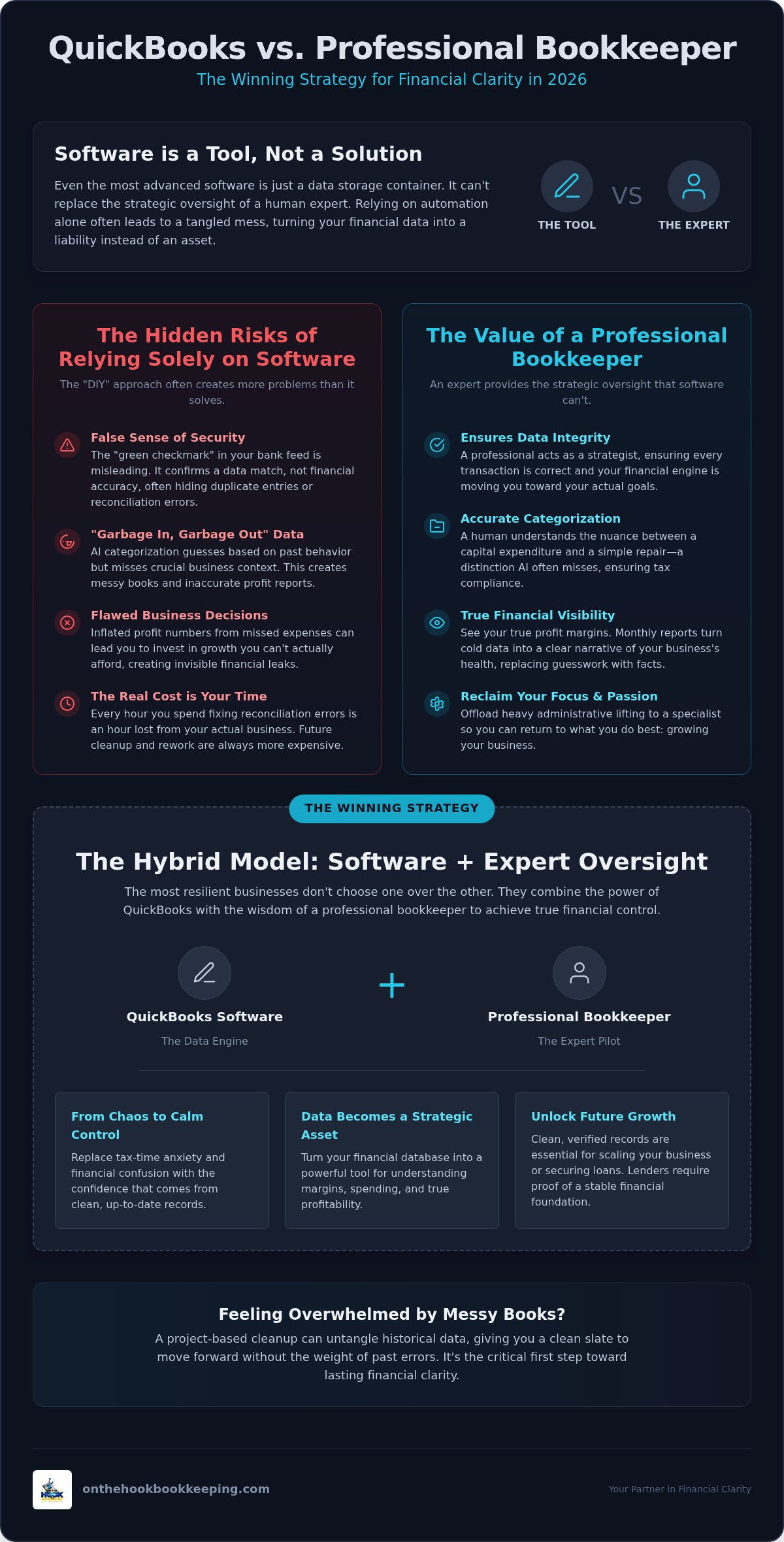
Software is a storage container, not a solution. Think of Accounting software like QuickBooks as a robust database for your financial history. It’s designed to house every receipt and invoice you generate. However, when you look at the QuickBooks vs professional bookkeeper dynamic, the software is merely the tool. The bookkeeper is the pilot. They act as the strategist who ensures data integrity, making sure the engine is actually moving you toward your goals.
Automation often fails because it lacks the ability to reason. It can record a payment, but it can’t tell if that payment was a capital expenditure or a simple repair. Without human oversight, these small automated choices create a ripple effect of errors. You might think you’re saving time, but you’re often just delaying a massive cleanup project. A professional provides the steady hand needed to keep the system calibrated.
The Reality of Transaction Categorization
AI-driven categorization in QuickBooks often leads to messy books that hide your actual profit. The software guesses based on past behavior, but it misses the nuance of your specific trade. Accurate transaction categorization is the backbone of tax compliance. When evaluating the QuickBooks vs professional bookkeeper choice, remember that the human element prevents garbage in, garbage out data entry. Your year-end reports shouldn’t be a work of fiction. A bookkeeper ensures every line item is positioned correctly, providing the visibility you need to make growth decisions without the anxiety of a future audit.
The Hidden Risks of Relying Solely on QuickBooks Software
That little green checkmark in your bank feed is one of the most dangerous features in modern software. It provides a false sense of security, leading you to believe your records are accurate simply because they’re matched. In reality, software frequently creates duplicate entries or leaves bank reconciliations uncleared for months. When weighing the QuickBooks vs professional bookkeeper debate, remember that software can’t tell you if your data reflects reality. It just tells you the numbers are in the system.
Inaccurate data leads to poor business decisions. If profit reports are inflated by missed expenses, you might invest in growth you can’t afford. When evaluating the QuickBooks vs professional bookkeeper dynamic, the human element catches these invisible leaks. To understand why this matters, look at the core definition of What Is Bookkeeping? It’s the process of ensuring every dollar is accounted for so you can see your true margins. Without this clarity, financial anxiety becomes a constant weight.
The Real Cost of DIY Bookkeeping for Owners
Every hour you spend squinting at a screen trying to fix a reconciliation error is an hour lost to your primary trade. This is the massive opportunity cost of DIY management. You might save a few dollars today, but you’ll pay more later when a professional must perform cleanup to fix historical errors. Rework is always more expensive than doing it right the first time. If you’re ready to reclaim your focus, it’s time to stop doing your own bookkeeping and let a specialist handle the administration. Partnering with a professional allows you to offload the heavy lifting so you can return to your passion.
Why the Best Financial Strategy Combines Software with Professional Oversight
The decision between QuickBooks vs professional bookkeeper shouldn’t be a binary choice. The most resilient small businesses in 2026 embrace a hybrid model. They leverage the raw processing power of QuickBooks Online while relying on a dedicated professional to interpret and verify the data. This partnership provides a level of visibility into business margins and spending that software alone can’t replicate. It turns a cold database into a strategic asset.
When you move beyond the simple QuickBooks vs professional bookkeeper comparison, you see that monthly financial reports turn your data into a narrative of your business health. Instead of checking your bank balance and hoping for the best, you receive a clear breakdown of your performance. This shift replaces confusion with a sense of calm control. Clean books are also your ticket to growth. Whether you’re looking to scale or apply for a loan, lenders require verified records that prove your business is a safe bet.
Cleanup and Catch-up: Starting from a Clean Slate
If your records are currently a tangled mess of digital transactions, a project-based cleanup untangles that historical data. It provides the clean slate you need to move forward without the weight of past errors. This is a critical component of professional bookkeeping for trades, ensuring your foundation is built on accurate project costs rather than rough estimates. For trade professionals and contractors, a dedicated approach to bookkeeping for home service businesses can bridge the gap between the job site and your ledger, giving you the scalable system you need to grow with confidence. Handing off the heavy lifting of administration to a steady hand allows you to focus entirely on your craft while knowing your records are in order.
Reclaim Your Focus and Drive Growth in 2026
Financial anxiety shouldn’t be the price of business ownership. As you’ve seen, the QuickBooks vs professional bookkeeper choice isn’t about picking a side. It’s about building a partnership. Software provides the engine, but a professional ensures you’re actually heading toward profit. By offloading the administration, you gain more than just clean, up-to-date financial records. You gain the mental space to focus on your primary craft.
With expert transaction categorization and regular monthly financial reporting, you can stop guessing and start leading. It’s time to move from confusion to empowered decision-making. Get the financial clarity your business deserves; contact On the Hook Bookkeeping today. You’ve built your business with grit and passion. Let us handle the heavy lifting so you can keep building something great.
Frequently Asked Questions
Is QuickBooks enough for a small business without a bookkeeper?
QuickBooks is a powerful tool, but it rarely provides a complete solution on its own. Software doesn’t understand the specific nuances of your trade or catch subtle categorization errors. Without a human strategist to verify the data, you risk making decisions based on “garbage in, garbage out” reports. A professional ensures your records are accurate enough to support real growth.
How much does a professional bookkeeper cost compared to a QuickBooks subscription?
A software subscription is a fixed monthly expense, while a bookkeeper is a service investment tailored to your business complexity. While DIY software seems cheaper, the hidden costs include hours of lost growth time and potential cleanup fees to fix historical errors. Most owners find that professional oversight pays for itself by providing the clarity needed to increase profit margins.
Can a bookkeeper help me fix my messy QuickBooks records?
Yes, a professional can untangle years of errors through project-based cleanup and catch-up services. This process involves reconciling old bank statements and correcting misclassified transactions to give you a clean slate. Having organized records is a prerequisite for business scaling or applying for loans, as it provides the verified financial history that lenders and partners require to trust your numbers.
What is the difference between a QuickBooks ProAdvisor and a regular bookkeeper?
A QuickBooks ProAdvisor is a professional who has completed specific certification training through Intuit to master the software’s advanced features. While any bookkeeper can record transactions, a ProAdvisor understands the mechanical inner workings of the platform. When navigating the QuickBooks vs professional bookkeeper choice, choosing a certified expert ensures your software is optimized and your workflows are as efficient as possible.