
You check your bank balance and see a healthy number, yet a nagging feeling says you aren’t actually making a profit. It’s a common disconnect that keeps many owners awake at night. You likely started your business to build something meaningful, not to spend your weekends buried under a mountain of receipts. It’s exhausting to feel the constant weight of falling months behind on your entries. We understand that financial anxiety often stems from a lack of visibility into your own hard work.
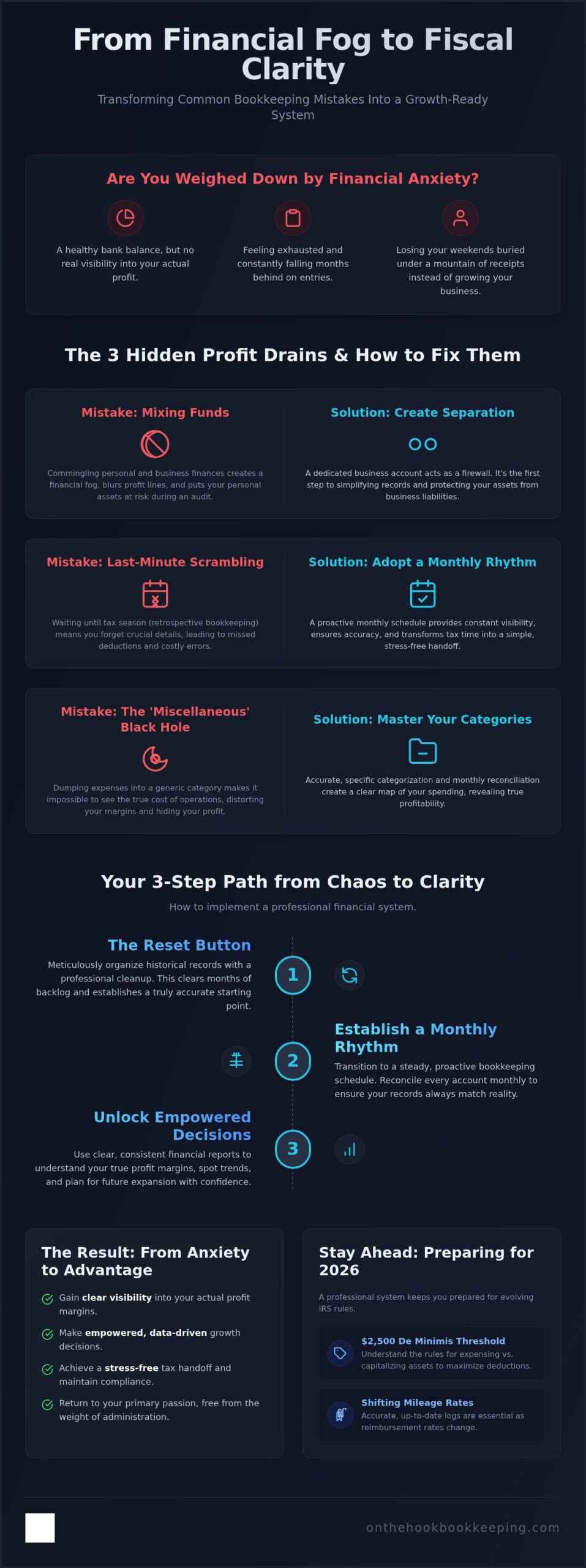
In this guide, we will uncover the common bookkeeping mistakes for small businesses that act as hidden friction, draining your time and resources. You’ll learn the structured steps to transform messy records into a growth-ready financial system. We will preview 2026 IRS updates like the $2,500 de minimis threshold and shifting mileage rates, showing you exactly how to achieve a stress-free tax handoff.
Key Takeaways
- Stop mixing personal and business funds to clear the fog surrounding your actual profit. Drawing a clear line between your life and your ledger is the first step toward protecting your assets.
- Identify the common bookkeeping mistakes for small businesses that lead to categorization chaos and missed deductions. Learn why the “Miscellaneous” account is a profit black hole you must avoid.
- Understand how a professional cleanup phase acts as a reset button for your historical records. Clearing away months of backlog is essential to moving from financial anxiety to calm control.
- Shift from reactive tax-season scrambling to a steady monthly rhythm of financial reporting. This consistent visibility provides the clarity you need to make empowered growth decisions.
The Foundation of Friction: Commingling and Retrospective Bookkeeping
Many entrepreneurs start with a single bank account and a “figure it out later” mindset. This creates a state of financial fog. You see cash in the bank, but you don’t know if it’s earmarked for payroll, taxes, or next month’s supplies. This lack of visibility is one of the most common bookkeeping mistakes for small businesses because it replaces confidence with guesswork. Commingling is the act of mixing personal and business funds in a single account, a practice that blurs financial lines and significantly increases your vulnerability during an IRS audit.
Waiting until tax season to record transactions is known as retrospective bookkeeping. It’s a recipe for disaster. By the time you sit down in March 2026, the context for last June’s expenses is gone. You lose out on deductions simply because you’ve forgotten the details. Following core bookkeeping principles requires a proactive approach to maintain accuracy and peace of mind.
Why Separating Personal and Business Finances is Your First Priority
A dedicated business account acts as a firewall. It simplifies transaction categorization and is vital for protecting your personal assets from business liabilities. Avoiding these common bookkeeping mistakes for small businesses starts with this single, clear boundary. In 2026, the “shoebox” method of saving paper receipts is a liability. Digital recordkeeping is no longer optional; it’s the standard for mechanical efficiency. If you’ve already mixed funds, don’t panic. You can hit the reset button with the right support.
- Open a dedicated business checking account immediately.
- Stop all personal spending from that account.
- Partner with On the Hook Bookkeeping for cleanup and catch-up support to untangle historical records.
Categorization Chaos: How Misclassified Transactions Distort Your Margins
When the workday gets hectic, it’s tempting to dump mysterious expenses into a “Miscellaneous” account. This is one of the most common bookkeeping mistakes for small businesses because it creates a black hole where your profit simply disappears. Without specific labels, you can’t see the true weight of your overhead or the actual cost of your materials. Incorrectly tagged items lead to missed tax deductions, often resulting in overpaid tax estimates that drain your vital cash flow.
Bank account reconciliation is the mechanical check that keeps your records honest. It’s the only way to spot bank errors, unauthorized duplicate charges, or missed entries. Reconciling ensures that your digital records match the reality of your bank statements. Accurate categorization isn’t just about taxes. It’s about visibility. It allows you to see exactly where every dollar goes, transforming a messy ledger into a clear map of your spending.
The Mechanics of Accurate Monthly Financial Reports
Reconciling every account monthly ensures your bank balance is the actual truth. This rhythm reveals if your jobs are truly profitable or just busy work that keeps you tired but broke. While you can leverage QuickBooks Online to automate entries, you shouldn’t lose the oversight of a professional eye. A machine doesn’t understand the nuance of your specific trade. If your categories feel like a puzzle you can’t solve, our monthly financial reports provide the clarity you need to move forward with confidence.
From Chaos to Clarity: Implementing a Professional Financial System
Fixing common bookkeeping mistakes for small businesses often requires a dedicated “reset button.” This is the cleanup phase. It involves meticulously organizing months or even years of historical financial records to ensure your current starting point is actually accurate. Once the historical fog is cleared, transitioning to a steady monthly bookkeeping rhythm allows you to maintain constant visibility into your profit margins. You stop reacting to old errors and start planning for future expansion with a clear head.
Accurate payroll processing is another essential pillar of a professional financial system. It keeps your team happy and ensures your records remain compliant with complex 2026 federal requirements. When you position professional bookkeeping as an investment in your company’s growth rather than just a dry administrative cost, you unlock the power to make empowered decisions. It’s about removing the heavy lifting of administration so you can return to your primary passion.
When to Transition from DIY to Professional Monthly Support
There comes a specific point where “doing the books” starts actively taking away from “doing the work.” If you find yourself spending your limited weekend hours on spreadsheets instead of on job sites or with your family, you’ve likely outgrown the DIY stage. On the Hook Bookkeeping handles the heavy lifting of cleanup and monthly reporting for you. We act as a seasoned partner, providing the steady hand needed to manage your financial administration with grit and reliability. This partnership restores your focus and brings a sense of calm control to your environment.
Reclaiming Your Financial Focus
You’ve seen how common bookkeeping mistakes for small businesses, like commingling funds or letting transactions pile up, can lead to a state of financial fog. It’s not just about the numbers; it’s about the friction that stops you from moving forward. By establishing clear boundaries between your accounts and implementing a monthly rhythm, you replace anxiety with a sense of calm control. You deserve to work with a partner who understands the mechanical inner workings of your trade.
On the Hook Bookkeeping provides the steady hand you need to fine-tune your operations. We offer specialized cleanup and catch-up support to hit the reset button on your records, alongside accurate payroll solutions and monthly visibility into your business margins. You built your business on grit and passion. Don’t let a messy ledger hold you back from the growth you deserve.
Get your time back with a free bookkeeping consultation
Frequently Asked Questions
What is the most common bookkeeping mistake small businesses make?
The most frequent error is commingling personal and business bank accounts. This practice creates a thick fog around your actual cash position and makes it nearly impossible to track true profitability. It’s one of the most common bookkeeping mistakes for small businesses that we see. Separating these funds from day one is the only way to ensure your records are reliable and audit-ready.
How do I fix messy bookkeeping records before tax season?
Fixing messy records requires a structured cleanup and catch-up phase to organize historical transactions. You should start by reconciling every bank statement against your ledger to identify gaps or duplicates. Addressing common bookkeeping mistakes for small businesses early prevents the stress of falling months behind. This process ensures your records are clean and accurate before you hand them off for tax preparation.
Is it okay to use my personal credit card for business expenses?
It’s best to avoid using personal credit cards for business purchases because it blurs the lines of your financial administration. While you can technically reimburse yourself, doing this regularly creates unnecessary friction and increases the risk of missing deductions. Maintaining a dedicated business card ensures every transaction is automatically categorized, protecting your personal assets and keeping your monthly reports clean and professional.
Do I need a professional bookkeeper if I use QuickBooks Online?
QuickBooks Online is a powerful tool, but it’s only as accurate as the data entered into it. Automation often miscategorizes transactions, which can distort your margins and lead to errors. A professional bookkeeper provides the human eye needed to reconcile accounts and verify that your reports reflect reality. This partnership gives you the confidence to make growth decisions based on facts rather than software guesses.