

What if your financial records were a map for growth rather than a source of Sunday night dread? Most entrepreneurs start their businesses to build something meaningful. They don’t set out to spend ten hours a month wrestling with categorization errors or fearing an audit. It’s exhausting to feel like you’re constantly behind, staring at a spreadsheet that refuses to balance while your actual work sits untouched. You deserve to feel in control. Investing in professional small business bookkeeping services isn’t just about outsourcing a chore; it’s about reclaiming your time and gaining the clarity needed to scale.
We understand the weight of messy records, and we know how to lift it. This guide explores how a steady hand on your books provides you with accurate monthly reports and the confidence to face upcoming deadlines without a single moment of panic. We’ll walk through the path from financial chaos to a finely tuned engine that supports your primary passion. By the end, you’ll see how organized data becomes the mechanical advantage your business needs to thrive in 2026.
Key Takeaways
- True financial clarity comes from moving beyond the “bank balance method” to a system that tracks every dollar with precision.
- Professional small business bookkeeping services handle the heavy lifting of categorization and reconciliation, giving you back ten or more hours every month.
- Choosing the right service model means balancing the reliability of a virtual partner against the high overhead of in-house staff or the risks of DIY software.
- Messy or behind records are a normal part of scaling, but specialized cleanup services can restore order and provide a fresh start for strategic growth.
- Accurate monthly financial reports provide the steady hand and visibility needed to make empowered decisions without the fear of categorization errors.
What Are Small Business Bookkeeping Services and Why Do They Matter?
At its core, professional bookkeeping is the mechanical heartbeat of your company. It involves the systematic recording, organizing, and tracking of every financial transaction that passes through your accounts. While many owners start by managing their own ledgers, What is bookkeeping? goes far beyond simply keeping a list of expenses. It’s about creating a clear, verifiable history of your business’s health. Without this foundation, you aren’t really driving your business; you’re just reacting to it.
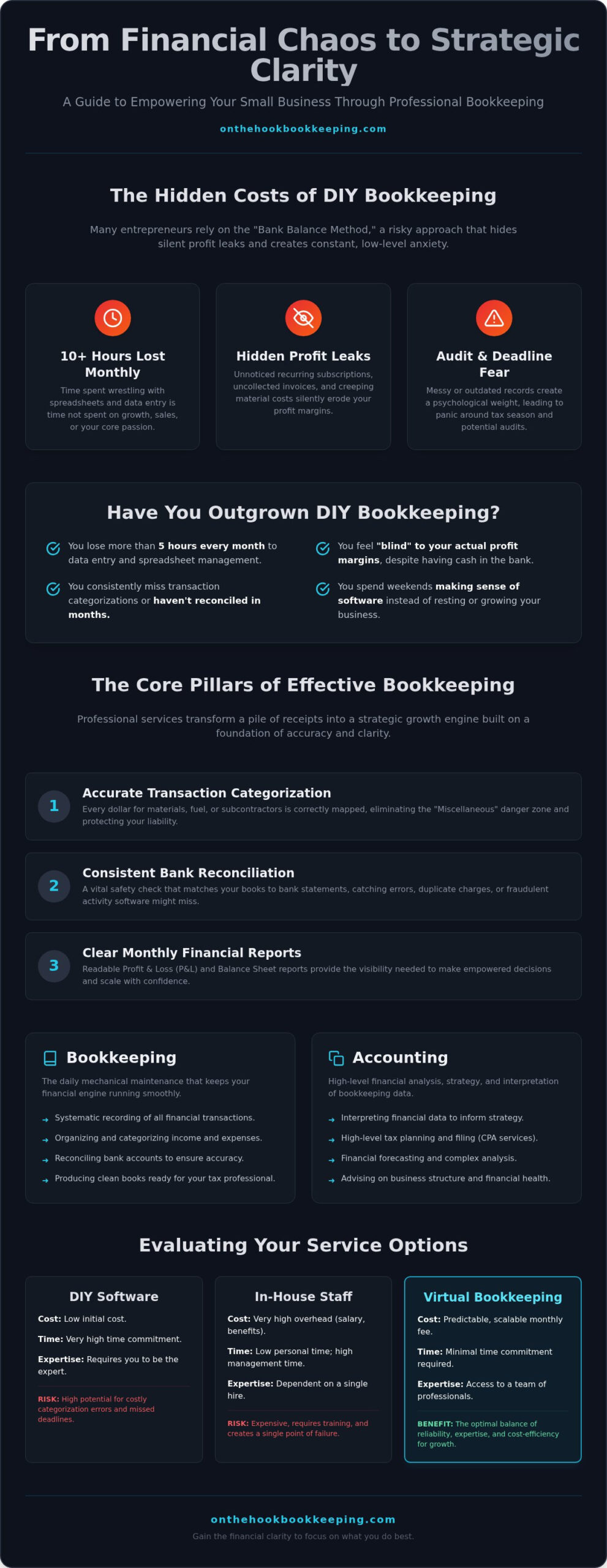
Many entrepreneurs rely on the “Bank Balance Method” of management. They check their banking app, see a positive number, and assume everything is fine. This approach is a trap. A healthy bank balance can hide “silent” profit leaks, such as recurring subscriptions you no longer use, uncollected invoices, or creeping material costs that erode your margins. Small business bookkeeping services replace this guesswork with grounded visibility. Instead of wondering where the money went at the end of the month, you have a precise map of every dollar’s journey.
The true value of professional oversight is often psychological. There’s a specific type of weight that sits on your shoulders when your records are messy or “behind.” It’s a constant, low-level anxiety that spikes every time you think about an audit or a deadline. Professional bookkeeping removes that burden. It replaces financial chaos with a sense of calm control, allowing you to return your focus to the work you actually love doing.
The Difference Between Bookkeeping and Accounting
It helps to think of bookkeeping as the daily maintenance that keeps your engine running. It focuses on the mechanical recordkeeping and transaction categorization. At On the Hook Bookkeeping, we specialize in this vital daily work, ensuring your data is clean and your accounts are reconciled. Accounting, by contrast, involves high-level tax strategy and complex financial analysis. While we don’t provide CPA services or tax filing, our work ensures your books are perfectly prepared for a seamless handoff to your tax professional when the time comes.
Signs Your Business Has Outgrown DIY Bookkeeping
Growth is exciting, but it often breaks the manual systems that worked when you were smaller. You’ve likely outgrown the DIY phase if any of the following feel familiar:
- You’re losing more than 5 hours every month to data entry and spreadsheet wrestling.
- You consistently miss transaction categorizations or haven’t reconciled your bank statements in months.
- You feel “blind” to your actual profit margins despite having cash in the bank.
If you’re spending your weekends trying to make sense of QuickBooks instead of resting or growing your revenue, it’s time to bring in a steady hand. Understanding why it’s critical to stop doing your own bookkeeping in 2026 can help you recognize the structural ceiling that DIY financial management places on your growth potential.
The Core Pillars of Effective Bookkeeping Support
Effective bookkeeping is built on four structural pillars. These aren’t just administrative tasks; they’re the mechanical adjustments that keep your business from veering off course. When you invest in small business bookkeeping services, you’re ensuring that every gear in your financial machine is properly lubricated and aligned. This systematic approach transforms a pile of receipts into a strategic growth engine.
Accurate Transaction Categorization for Trades
For tradespeople and service business owners, the “Miscellaneous” category is a danger zone. If you’re dumping unclear expenses into a catch-all bucket, you’re creating a fog that hides your true costs. Accurate categorization ensures every dollar for materials, fuel, or subcontractors is mapped to the correct chart of accounts. This is especially vital for protecting your liability. Mixing personal and business expenses is a common mistake that can jeopardize your legal protections. A clear separation, often outlined in a professional Small Business Bookkeeping Guide, makes the eventual tax-time handoff simple and stress-free. For tradespeople specifically, professional bookkeeping for trades provides the specialized financial scaffolding needed to turn your hard work into a scalable, predictable asset.
The next essential step is bank account reconciliation. This process involves verifying that your books match your actual bank and credit card statements. It’s a vital safety check. Reconciliation catches bank errors, duplicate charges, or missed entries that software alone might overlook. It ensures your financial records represent reality, not just a rough estimate of what you think happened during the month.
Monthly Financial Reports You Actually Understand
Data is only useful if it’s readable. Monthly financial reports, specifically the Profit & Loss (P&L) statement and the Balance Sheet, provide the visibility you need to scale. The P&L tracks where your revenue goes before it ever hits your pocket. This helps you identify which service lines are your most profitable and which are draining your resources. Meanwhile, the Balance Sheet shows exactly what you own versus what you owe at any given moment. Understanding these numbers allows you to make decisions based on facts rather than feelings.
Managing a team adds a layer of complexity that can quickly become an administrative headache. Integrating payroll with your bookkeeping ensures employee pay and record organization are handled without the stress of manual entry. It keeps your business compliant and your team happy. If you’re ready to stop wrestling with spreadsheets and start seeing the full picture of your company’s health, exploring professional bookkeeping and payroll support is the next logical step toward financial clarity.
Evaluating Service Models: Virtual vs. In-House vs. Software
Choosing the right way to manage your books is like choosing the right mechanic for a specialized engine. You have three primary paths: hiring someone to sit in your office, doing it yourself with software, or partnering with a virtual service. Each model has its own set of trade-offs. While an in-house bookkeeper offers proximity, they also bring significant overhead. You’re responsible for payroll taxes, benefits, and providing a physical workspace. For many growing companies, this is an expensive and unnecessary burden.
On the other end of the spectrum is the pure DIY software approach. It’s the cheapest option, but it carries the highest risk. Software is a tool, not a professional; it requires a pilot to be effective. Relying solely on an automated algorithm often leads to “Garbage In, Garbage Out” errors that can haunt you for years. Virtual small business bookkeeping services provide the ideal middle ground. You gain the steady hand of an expert who understands your industry, combined with the remote efficiency that keeps costs predictable and manageable.
The Hidden Cost of DIY Bookkeeping
Many owners try to save money by handling the ledgers themselves. However, you have to calculate your own “hourly rate” to see the true cost. If you spend ten hours a month wrestling with spreadsheets instead of closing new deals, you’re actually losing money. There’s also a steep price for errors. Messy books often result in missed tax deductions and increased audit risks. Beyond the dollars, consider the value of your focus. What could you build for your company if you weren’t buried in data entry every Sunday night? Our in-depth guide on why you should stop doing your own bookkeeping breaks down exactly how these hidden costs compound over time and prevent real business growth.
Why QuickBooks Alone Isn’t a Strategy
QuickBooks is powerful, but it doesn’t replace professional judgment. One of the biggest traps for owners is the “auto-categorization” feature. The software might guess where a transaction belongs, but it doesn’t understand the nuances of your specific business. Without human review, your reports can quickly become a fiction that hides your actual financial health. A dedicated partner ensures your setup follows historical financial record organization standards. As this Small Business Bookkeeping Guide points out, a tool is only as good as the person using it. Having a professional at the wheel ensures your data remains clean, accurate, and ready for growth.
Catch-Up and Cleanup: Fixing the Financial Past
Many owners carry a quiet sense of shame about their financial records. If you haven’t reconciled a bank statement in six months or your QuickBooks file is a maze of uncategorized transactions, you aren’t alone. Messy books are a normal part of scaling. When your business grows faster than your administrative capacity, things slip. This isn’t a failure of leadership; it’s a symptom of success that simply requires a mechanical reset. Professional small business bookkeeping services specialize in this type of restoration, moving you from a state of chaos to a clean slate.
Untangling months or even years of mixed transactions is a methodical process. It’s about looking back to ensure the foundation of your business is solid. Once the historical data is corrected, the “Sunday night dread” of a messy ledger disappears. You gain the relief of knowing your records are accurate, verifiable, and ready for whatever comes next, whether that is tax season or a sudden opportunity for expansion. A professional approach to catch up bookkeeping gives you a structured path to restore your historical financials and move forward with total confidence.
Steps to a Successful Bookkeeping Cleanup
Restoring order requires a structured approach to ensure no detail is missed. We follow a logical progression to bring your books back into alignment:
- Step 1: Gathering all bank and credit card statements for the missing period to ensure every transaction is accounted for.
- Step 2: Identifying and removing duplicate entries or personal expenses that accidentally crossed over into the business ledger.
- Step 3: Reconciling every account to the penny for total accuracy against your actual bank balances.
- Step 4: Generating the final reports needed for your tax professional to ensure a smooth and accurate handoff.
Preparing for Loans and Growth
Clean historical data is more than just a psychological relief; it’s a tangible business asset. If you plan to apply for a business loan, banks typically require two to three years of clean Profit and Loss statements. They need to see a stable history of profitability before they’ll commit capital. Organized records also significantly increase the valuation of your business. If you ever decide to sell, a buyer’s due diligence will start with your books. Having a steady hand manage your historical record organization ensures that your past supports your future goals rather than hindering them.
Moving from financial chaos to a clean slate is an incredible feeling. It’s like clearing the clutter off a heavy workbench so you can finally see the project you’re building. Once the past is fixed, you can look forward with grounded confidence. If you’re ready for that fresh start, our cleanup and catch-up support can help you reclaim your financial clarity today.
Partnering with On the Hook Bookkeeping for Clarity
Choosing a partner for your finances is a significant decision. You need more than a software subscription; you need a steady hand. At On the Hook Bookkeeping, we position ourselves as an empathetic partner for busy owners and trades. We understand the grit required to build a company from the ground up. Our focus on monthly bookkeeping and payroll is designed to remove the administrative burdens that pull you away from your primary passion. We don’t just record numbers. We provide the clarity you need to make empowered, informed decisions about your future.
Many owners avoid seeking help because they feel behind. We offer a judgment-free approach to catch-up and cleanup services. Whether your records are a few months messy or years out of alignment, we see it as a mechanical problem to be solved, not a personal failing. Our goal is to move you from a state of confusion to one of calm control. Investing in professional small business bookkeeping services is the first step toward reclaiming your focus and your weekends.
What to Expect in Your First 30 Days
The transition to professional oversight should feel like a relief, not another chore. During your first month, we focus on a methodical onboarding process. This starts with securely connecting your QuickBooks and bank feeds to ensure we have a direct, accurate data stream. We then perform an initial review to identify immediate areas for cleanup or optimization. By the end of the first 30 days, you’ll receive your first professional report. Seeing your business through this clear lens is often the moment owners realize the true value of their investment.
Reclaim Your Time and Focus
The “On the Hook” promise is rooted in reliability. We establish recurring workflows so you can stop worrying about whether a transaction was categorized correctly or if payroll is on track. This stability allows for a critical shift in your leadership. You can finally stop “working in the business” by wrestling with spreadsheets and start “working on the business” by focusing on growth and strategy. It’s time to return to the work you love. You don’t have to carry the weight of your administration alone. Get your time back with a free consultation and see how a dedicated partner can transform your financial records into a strategic growth engine.
Take the Next Step Toward Financial Visibility
Financial clarity isn’t a luxury reserved for big corporations; it’s the mechanical foundation every tradesperson and service owner needs to grow. The transition from a chaotic spreadsheet to a strategic asset changes how you view your company’s future. By prioritizing accurate categorization and regular reconciliations, you move from reacting to your bank balance to making proactive, data-driven decisions. It’s about more than just numbers. It’s about regaining your weekends and the mental space to focus on the work that actually builds your legacy.
If you’re ready to leave the stress of messy ledgers behind, our team is here to help. As QuickBooks Online Certified ProAdvisors, we specialize in the unique needs of trades and home service businesses. Whether you need ongoing monthly support or are looking for cleanup and catch-up experts to fix the past, we provide the steady hand your business deserves. Schedule a Free Consultation with On the Hook Bookkeeping today to explore how our small business bookkeeping services can give you back your time. You’ve done the grit-heavy work of building your company from the ground up. Let us handle the heavy lifting of your administration so you can lead it with total confidence.
Frequently Asked Questions
How much do small business bookkeeping services typically cost?
Bookkeeping costs vary based on your transaction volume, the number of accounts reconciled, and the complexity of your operations. Many modern firms move away from hourly billing toward predictable monthly subscription fees. This provides business owners with a steady, manageable expense rather than a fluctuating bill. While software alone is cheaper, the value of professional small business bookkeeping services lies in the human oversight that prevents expensive errors and saves you hours of manual data entry.
Do I need a bookkeeper if I already use QuickBooks Online?
QuickBooks Online is a powerful engine, but it still requires a skilled pilot to reach the right destination. Software often miscategorizes transactions or fails to flag duplicate entries without human review. Investing in professional small business bookkeeping services ensures your chart of accounts is organized correctly and reconciles your statements to ensure the data is accurate. This partnership transforms a digital ledger into a reliable strategic tool that helps you understand your true profit margins.
Can a bookkeeping service help me if my records are a total mess?
Messy or “behind” records are a normal part of scaling a business, and we specialize in untangling them. Our catch up bookkeeping services focus on organizing historical data, reconciling missed months, and preparing your books for tax-time handoffs. We take a judgment-free approach to help you move from financial chaos to a clean slate. This process provides the fresh start needed to apply for loans or make informed growth decisions with grounded confidence.
What is the difference between a bookkeeper and a CPA?
Bookkeepers handle the daily and monthly mechanical recordkeeping, such as transaction categorization, payroll, and monthly financial reports. We act as the steady hand that maintains your engine’s performance. A CPA typically focuses on high-level tax strategy, filing returns, and conducting audits. While we don’t provide CPA services or tax preparation, our work ensures your records are perfectly organized so your tax professional can work efficiently without charging you for data cleanup.
How often will I receive financial reports for my business?
You should expect to receive comprehensive financial reports on a monthly basis. These typically include a Profit and Loss statement and a Balance Sheet, providing a clear lens through which to view your business performance. Regular reporting replaces the guesswork of the “bank balance method” with actual visibility into your margins. Having these documents delivered consistently allows you to identify trends early and make adjustments to your spending before small leaks become major problems.
Will a bookkeeping service also handle my employee payroll?
Yes, we provide full payroll processing and setup as part of our core offerings. Managing employee pay and the associated record organization is often one of the biggest administrative headaches for small business owners. We handle the recurring workflows to ensure your team is paid accurately and on time. By integrating payroll with your monthly bookkeeping, we create a seamless system that removes the heavy lifting of administration from your shoulders entirely.
Is virtual bookkeeping secure for my business bank accounts?
Virtual bookkeeping is highly secure and relies on encrypted connections to your financial data. We use secure bank feeds and QuickBooks integrations that typically provide “view-only” access to your transactions. This means we can categorize and reconcile your spending without having the ability to move or withdraw funds. We prioritize the protection of your sensitive information, ensuring that your financial records remain private while providing the remote efficiency your modern business requires.
What documents do I need to provide to my bookkeeper each month?
You’ll typically need to provide access to your bank and credit card statements, as well as any receipts for business expenses. If you have employees, you’ll also share payroll data and information on new hires. While we automate much of this through secure software connections, occasional manual uploads might be necessary for specific physical documents. Keeping these records organized ensures we can reconcile every account to the penny and deliver your reports on a predictable schedule.