
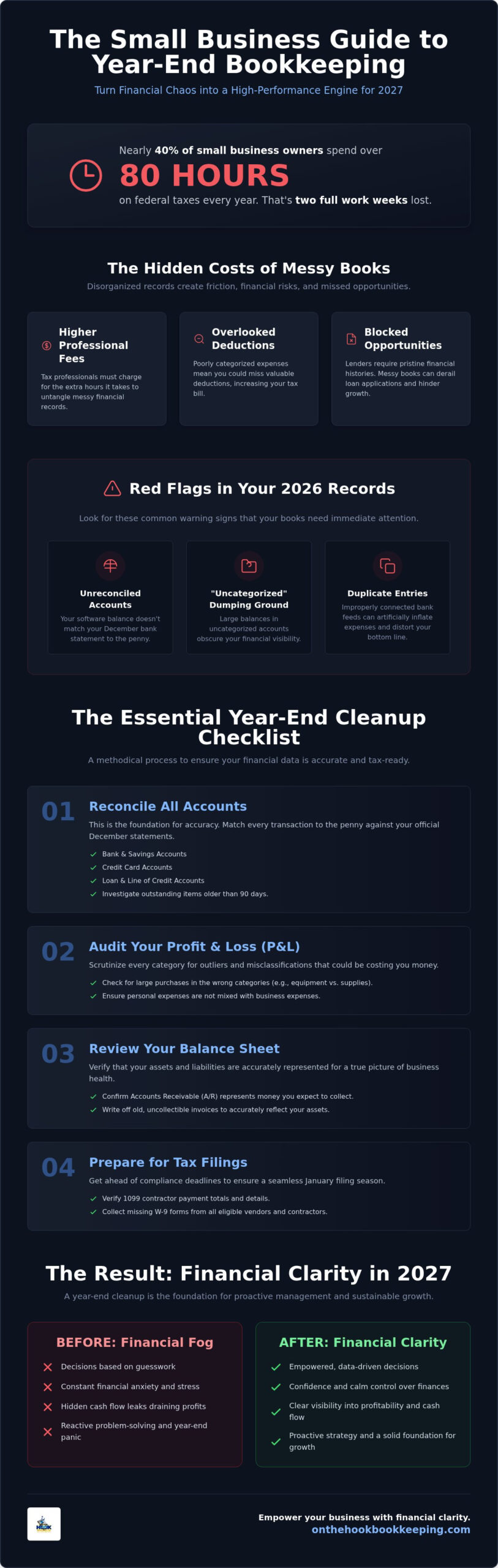
Nearly 40% of small business owners spend more than 80 hours every year on federal taxes. That is two full work weeks lost to administrative friction rather than growth. You likely started your business to pursue a passion, not to get buried under a mountain of uncategorized transactions and confusing software errors. It is exhausting to feel like your financial records are a tangled mess as the December deadline approaches, especially with increased IRS scrutiny on small business compliance this year.
A thorough year end bookkeeping cleanup is the mechanical fine-tuning that turns this chaos into a high-performance engine. This guide provides a structured checklist to help you untangle your records and hand over clean books to your tax professional with confidence. You will learn how to reconcile accounts, address mid-year mileage rate shifts, and generate the accurate reports needed for empowered decision-making in 2027.
Key Takeaways
- Identify the hidden costs of messy financials, including higher professional fees and the risk of overlooked tax deductions.
- Implement a structured year end bookkeeping cleanup by reconciling bank, credit card, and loan accounts against official December statements.
- Audit your Profit and Loss statement to catch software automation errors and ensure personal expenses aren’t clouding your business data.
- Establish a foundation for 2027 by moving from reactive cleanup to proactive monthly reporting that supports long-term growth.
Facing the Financial Fog: Why a 2026 Year-End Cleanup Matters
Running a business without clear financials is like driving through a thick fog. You might be moving, but you can’t see the obstacles ahead. A thorough year end bookkeeping cleanup is about more than just tax compliance. It’s about reclaiming your peace of mind. Disorganized records often hide missed deductions that could lower your tax bill. They also result in higher fees from professionals who must spend hours untangling the threads before they can even begin their work. Beyond the costs, messy books can even derail loan opportunities because lenders require pristine financial histories.
While modern software offers impressive automation, it cannot replace the human eye for detail. Algorithms often misinterpret complex transactions, leading to errors that stay buried in your ledger for months. Following standard methods of bookkeeping ensures that every dollar is accounted for correctly. Completing a year end bookkeeping cleanup now allows you to enter 2027 with a precise understanding of your profit margins. You deserve to make decisions based on data, not just a gut feeling.
Identifying the Red Flags in Your 2026 Records
Before you can fix the problem, you have to find the friction points. Look for these common warning signs that your books need attention:
- Unreconciled bank accounts: If your software balance doesn’t match your December bank statement to the penny, your reports are unreliable.
- The “Uncategorized” dumping ground: Large balances in “Uncategorized Expenses” or “Ask My Accountant” folders mean your visibility is clouded.
- Duplicate entries: Improperly connected bank feeds in QuickBooks often create double entries, which artificially inflate your expenses and distort your bottom line.
The Essential Year-End Bookkeeping Checklist for Small Businesses
A methodical year end bookkeeping cleanup is the only way to ensure your financial data is truly tax-ready. Automation pulls data in, but it doesn’t verify accuracy. You must reconcile every bank, credit card, and loan account to the penny against your official December statements. This step provides the foundation for everything else. It’s helpful to follow a fiscal year-end bookkeeping checklist to ensure no minor account or line of credit is overlooked during this phase.
Once reconciliations are complete, pivot to your Profit and Loss statement. Scrutinize every category for outliers. Did a large equipment purchase end up in “Supplies” instead of being capitalized? Are personal meals clouding your business margins? Finally, audit your Balance Sheet. Verify that your accounts receivable and accounts payable represent actual money owed. If you have stale invoices from early in the year that are clearly uncollectible, write them off now to keep your reports honest and your tax liability accurate.
Deep Dive: Reconciling and Categorizing for Tax Readiness
The reconciliation process often unearths outstanding checks or deposits that haven’t cleared the bank. Don’t let these linger indefinitely. Investigate any item older than 90 days to see if it needs to be voided or reissued. This period is also your deadline for verifying 1099 contractor details. Collect missing W-9s now so your January filing is seamless. If you discover your software is a maze of historical errors, you may need to fix messy QuickBooks records using a structured recovery plan. Performing a thorough year end bookkeeping cleanup provides the visibility you need to scale. Expert cleanup and catch-up support can take this burden off your plate, allowing you to return to your primary passion.
Transitioning from Cleanup to Financial Clarity in 2027
A successful year end bookkeeping cleanup isn’t just a hurdle to clear for taxes. It’s the moment you stop guessing and start knowing. Once your 2026 books are untangled, you can finally rely on monthly financial reports to guide your next move. These reports act as a compass, showing you which services are profitable and where cash flow is leaking. You deserve to move forward with a sense of calm control rather than financial anxiety.
This is where catch up bookkeeping proves its worth. By fixing historical errors, you build a solid foundation for sustainable growth. Consulting a comprehensive year-end accounting checklist helps you see the bigger picture beyond just transaction entry. It’s about strategy, not just data. You gain the confidence to invest in new equipment or hire staff because your numbers are grounded in reality.
Setting Your Business Up for a Successful New Year
Prevention is easier than a cure. Establishing a monthly routine for transaction categorization ensures you won’t face another stressful crunch next December. Use your cleaned-up 2026 data to set realistic budgets and profit margin goals for 2027. Financial visibility is the ability to see exactly where every dollar goes before it leaves your account. This foresight allows you to pivot quickly when the market changes.
If the 2026 cleanup felt like a second full-time job, it’s time to break the cycle. Many owners find that hiring professional small business bookkeeping services provides the relief needed to focus on their primary passion. You don’t have to carry the burden of administration alone. A thorough year end bookkeeping cleanup is a one-time project that gets you back on track for a successful 2027. A dedicated partner handles the heavy lifting so you can return to building your legacy.
Reclaiming Your Focus for a Profitable 2027
The weight of disorganized financials can slow down even the most driven entrepreneur. By following a structured year end bookkeeping cleanup, you replace that heavy burden with a sense of calm control. You’ve learned how to reconcile accounts to the penny, audit your Profit and Loss statement, and use accurate data to set realistic goals for the coming year. These steps aren’t just about satisfying the IRS; they’re about giving yourself the visibility needed to build a lasting legacy. If you want to ensure your historical records are fully organized before handing them off to your tax preparer, a dedicated bookkeeping cleanup for tax season transforms your messy financial history into a clean, tax-ready foundation. If you’re also planning to seek funding in the new year, taking the time to clean up business financials for loan approval ensures your records are lender-ready the moment opportunity arises.
If you’re tired of the DIY cycle and ready to focus on your primary passion, expert help is within reach. We provide professional cleanup and catch-up support to ensure your records are clean and up-to-date for tax time. Get your time back and fix your books with On the Hook Bookkeeping. You’ve worked hard to build your business. Let us handle the heavy lifting of administration so you can lead with confidence.
Frequently Asked Questions
How long does a typical year-end bookkeeping cleanup take?
The duration of a year end bookkeeping cleanup depends on the volume of transactions and the current state of your records. A business with relatively organized data might see a completion in a few days. If you haven’t reconciled accounts all year, the process often takes two to three weeks. We work methodically to untangle every historical error before tax season begins.
Can I do a bookkeeping cleanup myself if I use QuickBooks Online?
You can attempt a DIY cleanup, but software automation often falls short of true accuracy. QuickBooks Online frequently miscategorizes complex transfers or creates duplicate entries through bank feed glitches. A professional cleanup provides the expert oversight needed to catch these software errors. This ensures your financial reports reflect reality rather than just automated guesses, giving you total confidence in your data.
What documents do I need to gather for a year-end cleanup?
You need to gather several key documents to ensure a thorough year end bookkeeping cleanup result:
- Monthly bank and credit card statements through December 2026.
- Year-end loan and line of credit statements.
- Payroll reports and contractor W-9 forms.
- Receipts for major asset purchases.
Having these organized allows us to reconcile your accounts to the penny and verify every business deduction.
What is the difference between a bookkeeper cleanup and what a CPA does at year-end?
A bookkeeper performs the heavy lifting of organizing transactions and reconciling accounts to create a reliable financial foundation. We specialize in cleanup and monthly reporting to provide visibility. A CPA then takes those clean books to handle tax preparation and high-level financial planning. While we don’t file taxes, our work ensures your CPA receives accurate data without expensive administrative delays.