

What if the most intimidating part of your new company could actually be the most predictable? Most founders start their journey with a vision for their product, not a desire to decode complex tax tables. It’s completely natural to feel a knot in your stomach when thinking about 1099 versus W2 classifications or the looming shadow of an IRS audit. Getting the payroll setup for new businesses right the first time is about more than just cutting checks. It’s about building a foundation that stays out of your way. We understand that your focus belongs on your customers, not on administrative busy work.
This guide will show you how to construct a compliant, stress-free payroll engine from scratch. You’ll find a linear checklist that ensures your 2026 payroll taxes are handled correctly, giving you the confidence to grow without looking over your shoulder.
Key Takeaways
- Secure your business identity by obtaining an Employer Identification Number (EIN) and registering for necessary state and local tax IDs before your first hire.
- Protect your company from costly IRS reclassification penalties by accurately distinguishing between W-2 employees and 1099 contractors.
- Streamline the payroll setup for new businesses by creating a methodical onboarding process for essential documents like Forms W-4 and I-9.
- Calculate the “hidden cost” of administrative friction to decide whether automated software or managed support is the right engine for your growth.
Laying the Legal Foundation: Essential Registrations for New Employers
Building a business is about creating momentum. You can’t gain speed if you’re anchored by legal uncertainty or administrative doubt. The first phase of payroll setup for new businesses involves carving out your identity in the eyes of the government. It’s about moving from a “side hustle” mindset to a professional employer status with quiet confidence.
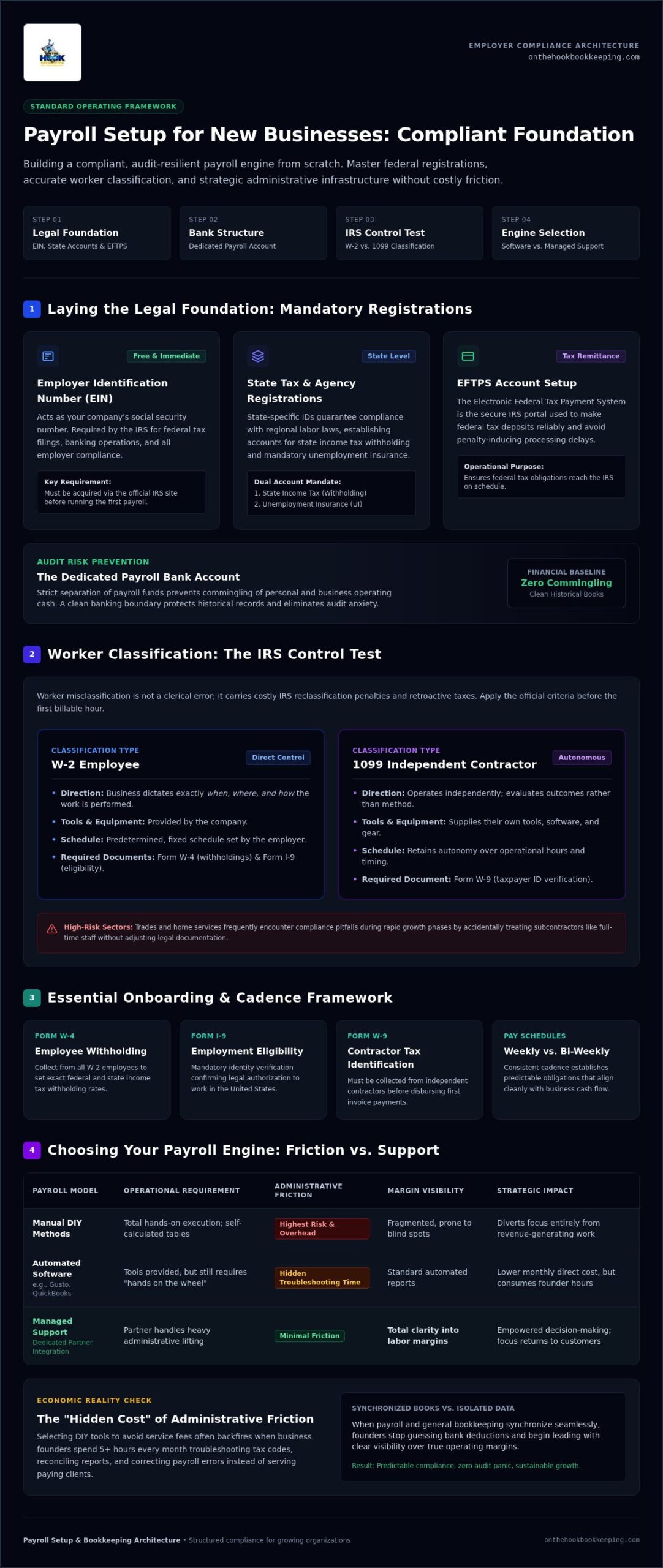
Your Employer Identification Number (EIN) acts as your company’s social security number. It’s the primary key for all federal filings and bank interactions. Beyond the federal level, you must register with specific state agencies for unemployment insurance and income tax withholding. These registrations ensure you’re compliant with regional labor laws from day one. To keep your records pristine, open a dedicated payroll bank account. This separation prevents the “commingling” of funds that often leads to audit anxiety. If your historical records are currently a tangle of personal and business expenses, starting with catch up bookkeeping is vital. You can’t build a reliable engine on a shaky foundation. Understanding payroll processing fundamentals helps you see why clean data is the fuel for this entire machine.
The Federal and State Registration Checklist
Success in this stage is about following a methodical path. Use this checklist to secure your standing as a 2026 employer:
- Apply for an EIN through the official IRS website. The process is free, and you’ll receive your number immediately upon completion.
- Identify which state agencies require registration. Most states require separate accounts for state income tax withholding and unemployment insurance.
- Set up your Electronic Federal Tax Payment System (EFTPS) account. This is the secure portal you’ll use to make federal tax deposits, ensuring your payments reach the IRS on time and without friction.
Classifying and Onboarding Your Team Without the Errors
Getting your team on the books is a significant milestone. It’s also a legal minefield if you guess instead of verify. Misclassifying a worker isn’t just a clerical error; it’s a financial risk that can lead to back taxes and heavy penalties. A successful payroll setup for new businesses in 2026 requires you to define the relationship with your team before the first hour is logged.
The W-2 vs. 1099 Decision Framework
The IRS uses a “Control Test” to determine worker status. Does your business dictate exactly when, where, and how the work is done? If you provide the tools and set the schedule, they’re likely a W-2 employee. If they operate independently, they might be a contractor. Trades and home services often struggle here during rapid growth, accidentally treating subcontractors like full-time staff. Reviewing the IRS worker classification guidelines helps you avoid these costly reclassification traps.
Once classified, you need a methodical onboarding process. For employees, collect Form W-4 for withholdings and Form I-9 to verify eligibility. For contractors, a Form W-9 is essential. Establishing a consistent pay schedule, whether weekly or bi-weekly, aligns your obligations with your cash flow. Finally, integrating this data with small business bookkeeping services provides total visibility into your margins. When your payroll and books talk to each other, you stop guessing and start leading. If you’re feeling overwhelmed by the paperwork, our team can help you find a steady path through our bookkeeping and payroll support.
Choosing Your Payroll Engine: Automation vs. Managed Support
Selecting the right platform is the final gear in your payroll setup for new businesses. You have three primary paths: manual DIY methods, full-service software like Gusto or QuickBooks, or managed payroll services. While software provides the tools, it still requires your hands on the wheel. Managed support, however, acts as a dedicated partner that handles the heavy lifting of administration. This shift allows you to move from a state of constant administrative anxiety to one of empowered decision-making. By receiving regular financial reports, you gain clear visibility into your labor margins instead of just staring at a list of bank deductions. It’s about restoring your focus to the work that actually grows the company.
Evaluating the Real Cost of Payroll Management
Many owners initially choose DIY software to minimize monthly fees. However, the “hidden cost” is the significant time you spend on administrative friction. If you spend five hours every month troubleshooting tax codes or double-checking entries, what is that time worth in lost customer work? A single filing error can often cost more in IRS penalties than an entire year of professional support. To make a fully informed decision, it helps to understand the cost of payroll services for small business, including how base fees and per-employee charges break down in practice. Following IRS employment tax guidelines requires absolute precision in withholding, depositing, and reporting. As your team expands throughout 2026, professional support serves as a steady hand that provides clarity in a chaotic environment. You shouldn’t have to fear the mechanical inner workings of your company. Instead, let an expert fine-tune your payroll setup for new businesses so you can return to your primary passion with total peace of mind.
Reclaiming Your Time and Focus
Building a business is an act of grit. You’ve learned that a successful payroll setup for new businesses starts with a solid legal foundation and precise worker classification. By moving away from the hidden costs of DIY administrative friction, you transition from financial anxiety to a state of calm control. You deserve a system that runs silently in the background so you can focus on the craftsmanship that built your company. If you’re ready to trade administrative busy work for total visibility into your margins, we are here to help. You can simplify your payday with professional payroll services that ensure clean, up-to-date financial records and timely workflows. Whether you’re in the trades or managing a growing team, we provide the steady hand you need to scale with confidence throughout 2026. Your passion shouldn’t be buried under paperwork. It’s time to get back to what you do best.
Frequently Asked Questions
How much does it cost to set up payroll for the first time in 2026?
Costs vary depending on your team size and the level of support you choose. You will usually face initial fees for software or professional setup assistance. It is essential to consider the value of your own time when calculating these expenses. A professional payroll setup for new businesses is a foundation that prevents the high cost of compliance errors down the road. For a detailed breakdown of what to expect, reviewing a comprehensive guide to the cost of payroll services for small business can help you budget with confidence.
Can I pay my employees through apps like Venmo or Zelle?
Paying employees through peer-to-peer apps like Venmo or Zelle is generally discouraged for business compliance. These personal tools do not automatically calculate or withhold taxes. They also make it difficult to maintain the clean financial records required for an audit. Using a managed payroll engine ensures that every payment is properly tracked, categorized, and reported to the necessary government agencies.
What is the difference between gross pay and net pay for my records?
Gross pay represents the total earnings of an employee before any deductions are applied. Net pay is the final amount they receive after all taxes and benefits are withheld. For a successful payroll setup for new businesses, your system must accurately document both values. This clarity allows you to see your actual labor costs and maintain precise margins in your monthly financial reports.
What happens if I miss a payroll tax deadline?
Late payroll tax deposits or filings usually trigger significant penalties and interest from the IRS. These fees often increase the longer the debt remains unpaid. If you have missed deadlines in the past, cleanup and catch-up support can help you resolve historical issues. Moving to a structured, professional workflow ensures your future payments remain timely, accurate, and stress-free.