

What if the hours you spend wrestling with spreadsheets are actually costing you more than the billable time you’re losing? It’s a heavy realization. You started your firm to solve complex problems for your clients, not to become an unpaid, part-time accountant. You likely feel the weight of messy records and the nagging anxiety of unpredictable cash flow. It’s exhausting to trade your energy for tasks that don’t move the needle. Reliable bookkeeping for consultants is the first step toward reclaiming that lost ground.
This guide shows you how to streamline your firm’s finances, track project profitability with precision, and reclaim your time for high-value client work. We will walk through the essential steps to achieve tax-ready books and clear margin visibility. By the end, you will understand how to replace financial confusion with a sense of calm control and empowered decision-making.
Key Takeaways
- Identify why standard accounting models often fail consultants and how to capture every billable hour that currently slips through the cracks.
- Establish a rock-solid financial foundation using the five pillars of effective bookkeeping for consultants to ensure your records are always accurate and tax-ready.
- Gain the visibility needed to evaluate project margins, allowing you to focus your expertise on the most profitable areas of your business.
- Learn how transitioning from messy DIY spreadsheets to professional cleanup and monthly support can reclaim your time and fuel long-term firm growth.
The Unique Challenges of Bookkeeping for Consultants
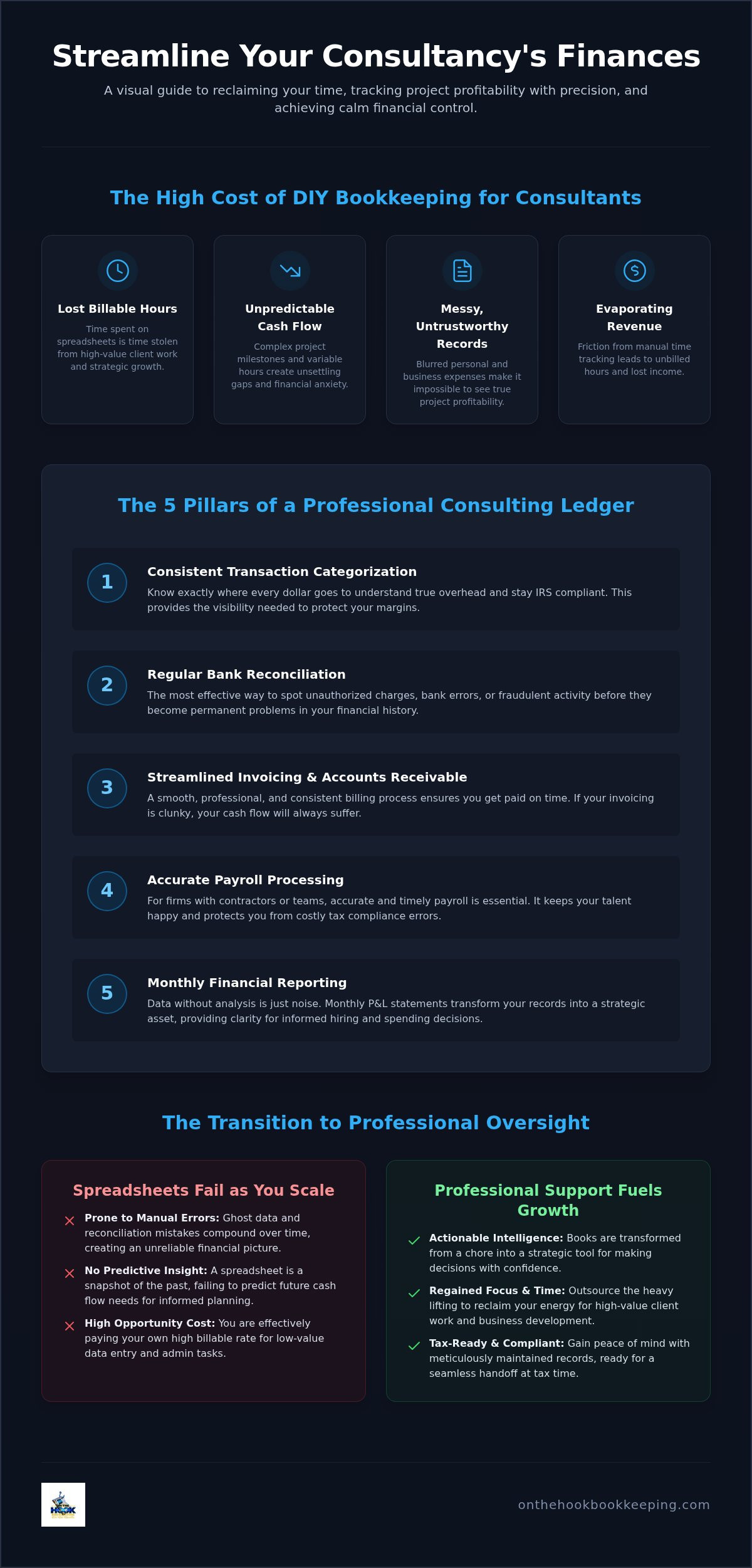
Selling expertise is fundamentally different from selling products. Unlike a retail store with daily transactions, your income flows through complex project milestones and variable billable hours. This creates a rhythmic unpredictability that can be unsettling. Without a steady hand on your ledger, cash flow gaps often feel like a sudden drop in altitude. You need a system that understands these cycles rather than fighting them.
Effective bookkeeping for consultants requires deeper insight than a simple bank balance. It demands project-level visibility to protect your margins. Many new consultants also face the invisible hurdle of separating personal expenses from business costs. This blurriness makes it impossible to see if a specific engagement is truly profitable. Additionally, the friction of manual time tracking often leads to unbilled hours; it’s revenue that simply evaporates because the record-keeping felt too heavy in the moment.
Why Spreadsheets Fail as You Scale
Manual spreadsheets are a common starting point, but they don’t grow with you. Manual entry inevitably leads to ghost data and reconciliation errors that compound over time. While a spreadsheet provides a snapshot of the past, it fails to predict future cash flow needs. To understand the foundational principles of this work, you can look into What is Bookkeeping? to see how professional standards differ from basic lists.
There is also a hidden cost to the DIY approach. If you spend several hours each month on administrative tasks, you’re effectively paying your own high billable rate for data entry. That’s time stolen from high-value client work and strategic growth. Professional bookkeeping for consultants turns those spreadsheets into actionable intelligence, allowing you to focus on the work you actually enjoy. Transitioning to professional oversight is a hallmark of a maturing consultancy.
5 Pillars of a Professional Consulting Ledger
Moving beyond a messy checkbook requires a structured approach. It’s about building a financial machine that supports your growth rather than slowing it down. Consistent transaction categorization is the first pillar. You need to know exactly where every dollar goes to understand your true overhead. This isn’t just for your own peace of mind; following IRS Record-Keeping Guidelines ensures you stay compliant while gaining much-needed visibility into your operation. Establishing professional bookkeeping for consultants starts with these fundamental pillars.
The second pillar involves regular bank reconciliation. It’s the most effective way to spot unauthorized charges or bank errors before they settle into your history. Next, you must prioritize streamlined invoicing and accounts receivable. If your billing process is clunky, your cash flow will suffer. For firms that utilize contractors or growing teams, accurate payroll processing is essential. It keeps your talent happy and protects you from tax errors. When these five areas move from a state of chaos to a state of calm control, you can finally breathe easier.
The Importance of Monthly Financial Reporting
Data without analysis is simply noise. Monthly P&L statements provide the clarity needed to make informed hiring or spending decisions. By tracking your spending with precision, you can identify “leaks” in your business margins before they turn into financial crises. This level of Small Business Bookkeeping Services transforms your records from a chore into a strategic asset. If your current ledger feels like a heavy burden, our monthly bookkeeping support can act as the steady hand you need to regain your focus.
Scaling Your Consultancy with Professional Financial Support
Transitioning from DIY spreadsheets to professional oversight is a hallmark of a maturing consultancy. It represents the moment you value your expertise enough to stop playing the role of a part-time administrator. While software is a useful tool, it lacks the expert categorization and strategic oversight required for truly clean books. Professional bookkeeping for consultants provides a partnership that software alone cannot replicate. It’s about having a seasoned professional who understands the mechanical inner workings of your company and knows exactly how to fine-tune them for better performance.
If your records have fallen behind, specialized cleanup and catch-up services untangle historical messes to prepare you for seamless tax-time handoffs. A dedicated bookkeeper acts as a protective advocate, handling the heavy lifting so you don’t have to. Consulting a Small Business Bookkeeping Guide highlights the importance of this transition, yet the real value lies in the ongoing monthly service. This ensures your records are always current, providing a steady hand that offers clarity in an often chaotic environment.
Getting Your Time Back for High-Value Work
Your primary passion is consulting, not data entry. By outsourcing the administrative burden, you replace financial anxiety with a sense of calm control through reliable recurring workflows. You can return to solving complex problems for your clients while the financial mechanics are fine-tuned in the background. On the Hook Bookkeeping provides the stability needed to scale without the administrative burnout that often stalls growth. We act as your partner, removing the physical burden of paperwork so you can focus on the work you were meant to do.
Reclaiming Your Focus and Fueling Growth
The transition from financial anxiety to calm control starts with a single decision. You’ve seen how specialized revenue cycles and manual administrative friction can stall your momentum. By establishing a professional foundation, you move from guessing your profitability to knowing it with absolute certainty. Effective bookkeeping for consultants isn’t just about compliance; it’s about building a stable platform for your expertise to shine. Through accurate transaction categorization and clean monthly financial reports, you gain the visibility required to make empowered decisions for your firm’s future.
If your records currently feel like a heavy burden, specialized cleanup and catch-up support can untangle the past and set a clear path forward. You don’t have to carry the weight of administration alone. Get your time back with professional bookkeeping for consultants from On the Hook Bookkeeping. Let us handle the mechanical inner workings of your ledger so you can return to the high-value work you love. Your consultancy deserves a steady hand.
Frequently Asked Questions
Is bookkeeping different for consultants compared to other small businesses?
Yes, bookkeeping for consultants focuses heavily on tracking billable time and project profitability rather than inventory or high-volume daily sales. Consultants often deal with irregular revenue cycles and complex retainer models. This requires a ledger that prioritizes margin visibility for specific engagements. It’s about understanding how your expertise translates into profit across different client contracts rather than just tracking simple sales.
How do I handle messy QuickBooks records from previous years?
You don’t have to untangle historical messes alone. On the Hook Bookkeeping specializes in cleanup and catch-up support to organize messy QuickBooks records from previous years. We review your past transactions, reconcile accounts, and ensure everything is categorized correctly. This process prepares your books for tax-time handoffs and gives you a clean slate to build upon for future growth.
Can a bookkeeper help with my consulting invoices and receivables?
Yes, managing Accounts Receivable is a core part of professional bookkeeping for consultants. We can help you streamline your invoicing process to ensure you get paid on time. By tracking outstanding payments and managing your receivables, a bookkeeper removes the administrative burden of chasing clients. This creates a more predictable cash flow and lets you focus on delivering high-value work.
Do I need a professional bookkeeper if I already have accounting software?
Software is simply a tool, but it doesn’t provide the expert oversight needed for accurate records. Many owners find that software alone leads to “ghost data” or categorization errors that compound over time. A professional bookkeeper acts as a protective advocate. They ensure your data entry is correct and provide clean monthly financial reports that help you make empowered business decisions.