
Imagine opening your laptop to finally tackle your finances, only to be met by a mountain of uncategorized transactions and reconciling errors that stretch back for months. It’s a heavy, sinking feeling that many entrepreneurs know all too well. When your records fall behind, the fear of tax penalties or a surprise audit can start to overshadow your passion for the work. This is exactly why catch up bookkeeping is such a vital investment. It’s not just about fixing the past. It’s about clearing the path for your future.
We understand that historical records can feel like a tangled web that drains your energy. You deserve a fresh start with clean, tax-ready financial statements that provide a sense of calm control. This guide will teach you how to untangle messy data and restore clarity with a professional strategy. We’ll explore how to navigate the 2026 reporting thresholds and move from a state of confusion to one of empowered, accurate reporting.
Key Takeaways
- Understand how catch up bookkeeping acts as a mechanical reset, removing the administrative weight of messy records and restoring your professional focus.
- Follow a structured recovery process to collect fragmented data and categorize transactions, ensuring every dollar is accurately placed for tax-ready reporting.
- Discover the transition from a one-time cleanup project to a consistent monthly rhythm that provides real-time visibility into your business margins.
- Replace financial anxiety with a sense of calm control by establishing a reliable system that prepares you for audits and future growth.
The Hidden Cost of Falling Behind: Why Catch Up Bookkeeping is Non-Negotiable
Messy financial records are more than just an administrative headache. They act as a constant weight that drags on your focus and stalls your momentum. Catch up bookkeeping is the systematic process of bringing historical financial records up to date. While many owners associate this strictly with tax deadlines, the reality is that outdated books create an “invisible burden.” You simply can’t make confident, growth-oriented decisions when you’re operating in a state of financial blindness.
By adhering to standard methods of bookkeeping, you ensure that every transaction is accounted for and verified. This visibility is vital beyond just the IRS. If you’re applying for a loan or preparing for a business valuation, lenders require proof of stability. They won’t accept a pile of excuses about “fixing it later” when your company’s future is on the line.
Avoid the common “DIY Weekend” trap. Spending your limited free time on manual cleanup often leads to deeper errors, such as duplicated entries or miscategorized expenses. These mistakes usually result in much higher professional fees down the road when a specialist has to untangle the new mess you’ve created. Letting a professional handle the heavy lifting allows you to return to the passion that started your business in the first place.
Identifying the Red Flags in Your Financial Records
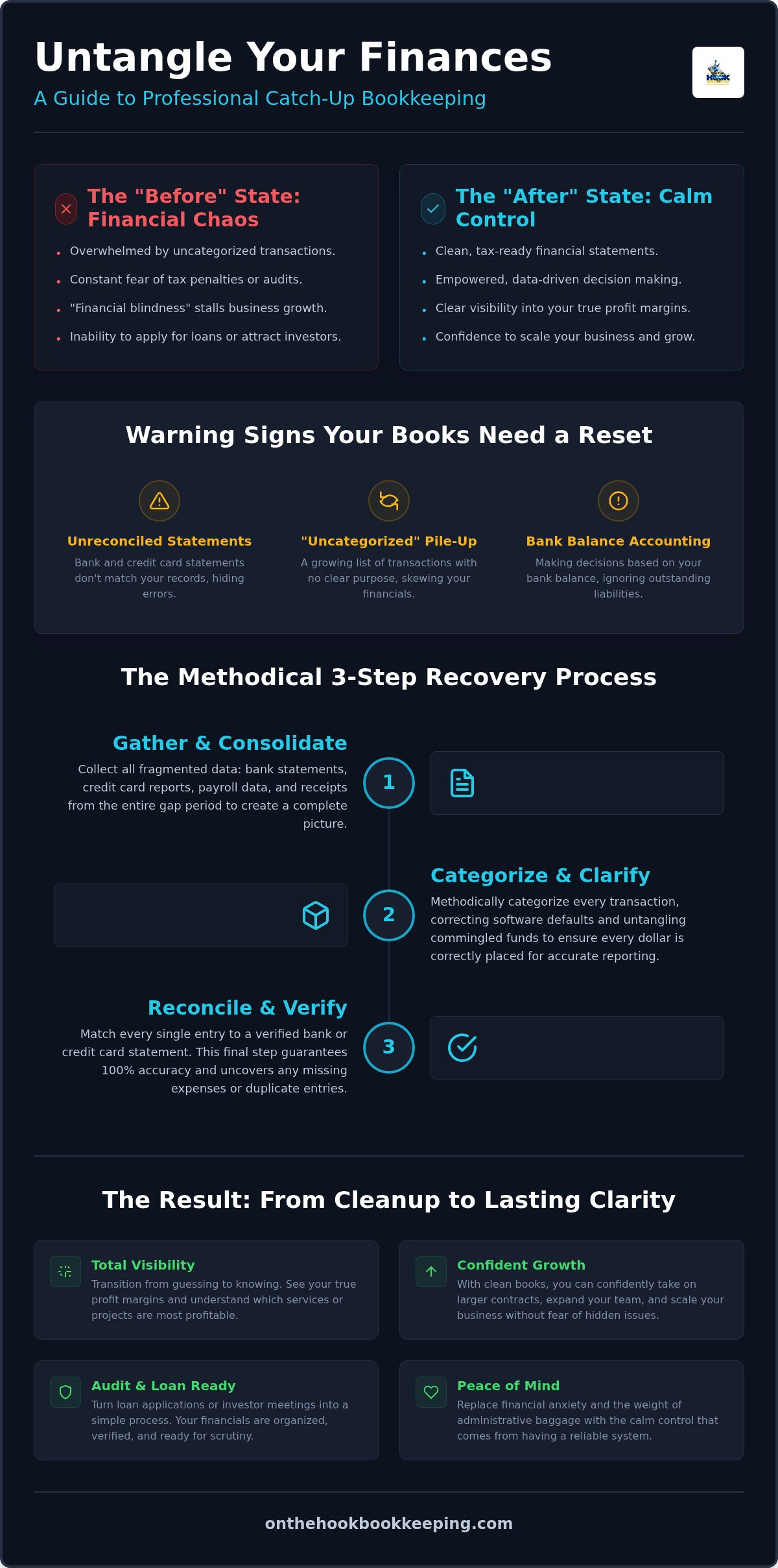
Watch for warning signs like unreconciled bank statements or a growing “uncategorized” bucket in your software. Many owners fall into the habit of “Bank Balance Accounting,” but this provides a false sense of security. It ignores outstanding liabilities, pending payroll, and your true profit margins. Catch up bookkeeping serves as a mechanical reset that restores total business clarity.
The Anatomy of a Professional Cleanup: Our Methodical Recovery Process
Restoring your financials requires a steady, disciplined hand. We start by gathering the fragments. This means collecting bank statements, payroll data, and receipts from the entire gap period to satisfy IRS record-keeping requirements. Once the data is in hand, we move to transaction categorization. Don’t rely on the QuickBooks default settings. Software often guesses wrong, especially when personal and business funds have been commingled. We ensure every dollar is correctly placed.
The final pillar of catch up bookkeeping is account reconciliation. We match every single entry to a verified bank or credit card statement. This ensures 100% accuracy and uncovers missing expenses you might have forgotten. This methodical cleanup is the foundation for transitioning to reliable small business bookkeeping services that keep you on track month after month.
Fixing Messy QuickBooks Records Without Starting Over
You don’t always need a brand new file to get a fresh start. We specialize in identifying and removing duplicate entries or stale checks that have cluttered your registers for years. A professional catch up bookkeeping strategy can breathe new life into an old file. This historical financial record organization is essential for a smooth tax handoff. We also fine-tune your Chart of Accounts. It should reflect the unique reality of your trade, whether you’re in construction or professional services. If you need a structured approach to fix messy QuickBooks records without risking your historical data, our step-by-step recovery guide walks you through every stage of the process. If you’re feeling overwhelmed by the backlog, let us handle the heavy lifting so you can return to your primary passion.
From Historical Cleanup to Future Visibility: What Happens Next?
A successful catch up bookkeeping project isn’t just a look in the rearview mirror. It’s the mechanical reset needed to move forward with purpose. Once your historical records are untangled, the transition to a consistent monthly rhythm begins. This shift replaces reactive panic with proactive strategy. You’ll move from wondering where the money went to knowing exactly where it’s going next. It’s the difference between guessing your profit and seeing it clearly on a page.
Leveraging this new data is where the real growth happens. With accurate monthly financial reports, you can finally see your true margins. You’ll identify which projects are profitable and which ones are draining your resources. This visibility creates a powerful confidence shift. When you aren’t weighed down by administrative baggage, you’re free to take on larger contracts and expand your team. Clean books also turn loan applications or investor meetings into a simple “click and send” process rather than a weeks-long crisis. You’ll have the stability required to scale without the fear of hidden financial traps. As December approaches, pairing your restored records with a thorough year end bookkeeping cleanup ensures you hand off accurate, tax-ready financials to your accountant with confidence.
The Peace of Mind Factor: Reclaiming Your Focus
Outsourcing the heavy lifting of bookkeeping allows you to return to the work you actually love. Building a business requires immense grit. You need a supportive partner who understands the mechanical inner workings of your specific trade. We act as that steady hand, handling the complex categorization and reconciliations so you don’t have to. It’s about restoring your focus and giving you the space to lead. Let us handle the cleanup so you can focus on growth.
Reclaim Your Financial Clarity and Focus
Historical records shouldn’t be a source of constant anxiety. By addressing your backlog, you remove the administrative weight that stalls your progress and reclaim the visibility needed to scale your business. Professional catch up bookkeeping is the mechanical reset that turns a chaotic past into a structured, predictable future. It’s about more than just numbers; it’s about restoring your ability to lead with confidence.
On the Hook Bookkeeping provides specialized support for trades and busy owners across our national US service area. We handle the heavy lifting through methodical transaction categorization and account reconciliation, allowing you to return to your primary passion. Get Your Books Back on Track with On the Hook today. You’ve built your business with grit and determination. Don’t let messy financials hold you back from the growth you’ve earned.
Frequently Asked Questions
What is catch up bookkeeping and how does it differ from monthly service?
Catch up bookkeeping is a project-based service designed to organize historical records and untangle messy books from the past. While monthly services focus on ongoing transaction categorization and real-time reporting, cleanup is a one-time mechanical reset. It prepares your business records for a smooth tax-time handoff or loan applications by resolving backlog issues that monthly maintenance isn’t built to handle.
How far back can a professional bookkeeper go to clean up my records?
Professional bookkeepers typically look back between one and two years for most cleanup projects. The goal is to restore accuracy for recent fiscal periods to ensure your current financial reports are reliable and grounded. Whether you’re six months behind or two years deep in uncategorized transactions, we can systematically untangle the mess to give you a fresh start.
How much does catch up bookkeeping typically cost for a small business?
The cost of catch up bookkeeping depends on the complexity of your records and the length of the backlog. Fees are typically project-based rather than hourly, reflecting the intensive labor required for transaction categorization and account reconciliation. Factors like the number of bank accounts, the volume of monthly transactions, and the state of your current software will influence the final investment.
Will I need to provide all my old receipts for a bookkeeping cleanup?
You don’t necessarily need every physical receipt, but we do require access to your bank and credit card statements for the gap period. Digital records of large purchases or payroll data are also essential for accurate reconciliation. We work with the fragments you have to build a complete picture, ensuring your historical financials meet standard record-keeping expectations without adding to your administrative weight.